


Wind River Cloud Platform

Organizations in enterprise and telecommunications sectors are rethinking how they operate their workloads across distributed cloud environments, from edge locations to centralized data centers. Rising cloud costs, operational complexity, performance concerns, and vendor lock-in are driving the search for more flexible, efficient, and scalable solutions.
Wind River® Cloud Platform provides a better way. It’s a commercially supported, enterprise-grade platform built on open technologies including StarlingX, OpenStack, and Kubernetes. Proven in some of the world’s largest mission-critical cloud deployments, the platform delivers high-performance compute with fault-tolerant, resilient architecture. It simplifies deployment and lifecycle management of complex cloud infrastructure , enabling organizations to run virtualized and containerized workloads with ultra-low latency, high availability, and automated operations.
KEY BENEFITS
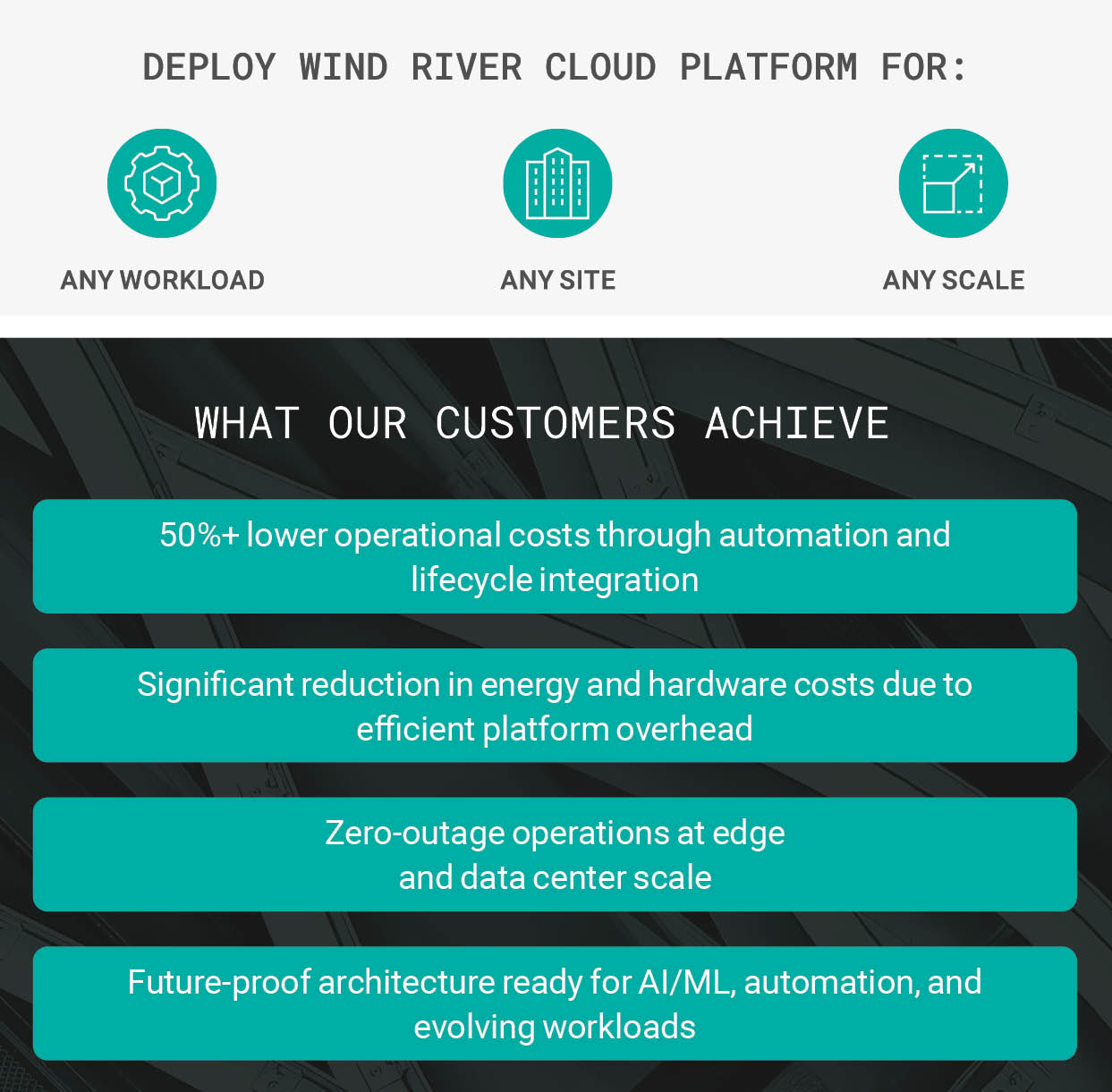
- Cost efficiency: With simplified licensing, a smaller footprint, reduced hardware costs, and lower operational costs than alternatives, you can reduce total cost of ownership for your cloud infrastructure.
- Open platform with full support: Avoid vendor lock-in with commercialized open source technologies such as StarlingX, OpenStack, and Kubernetes, backed by Wind River’s award winning customer support and services.
- Simplified lifecycle management: Stress-free infrastructure and workload operations include day 0 to day 2 automation across distributed cloud configurations.
- Designed for edge and enterprise: Deployed in small footprint, low-latency, mission-critical, and highly distributed architectures with remote management and up to six-nines reliability.
- Support for virtual machines (VMs) and containers: Manage virtualized and containerized workloads from a single technology stack and management toolset.
- Scalable for any size enterprise: Cloud Platform works for any organization, from small edge nodes to large enterprise data centers, using the same management and orchestration tools.
- Sovereign cloud readiness: Maintain full control over data, infrastructure, and lifecycle management while supporting deployments that require data residency, regulatory compliance, and operational autonomy.
- Built-in security and zero-trust protection: Strengthen security and compliance with integrated identity governance, role-based access control, encrypted communications, and zero-trust architecture across the platform.
- Compute and storage modernization: Enable flexible infrastructure modernization by supporting independent scaling of compute and storage and integration with internal or external enterprise storage solutions.
ENTERPRISE AND CARRIER SUPPORT
Wind River’s private cloud solution is backed by an award-winning global support organization that offers live help in multiple time zones, with 24/7 emergency recovery and service restoration and standard Tier 1 and Tier 2 break/fix support. The online Wind River Support Network, with multifaceted self-help options and optional premium services, provides developers fast time-to-resolution.
For more information, visit www.windriver.com/support.
CUSTOMER SUCCESS THROUGH EDUCATION AND TRAINING
Wind River offers onsite and virtual education and training courses for users of Wind River’s private cloud solution. Classes are instructor led or on demand through e-learning formats. These education and training services are designed to get teams to full user efficiency as quickly as possible. Classes start at the beginner level and extend to expert-level users. In addition, our customers have access to a customer success manager who can provide white glove service and direct access to Wind River experts.
For more information about Cloud Platform, visit https://www.windriver.com/products/enterprise/cloud-platform, email inquiries@windriver.com, or contact your Wind River account management team.