



Sovereign Cloud Stats Every CIO Needs Before Their Next Board Meeting
Increasingly, countries are laying claim to companies’ customer data. In response, companies are turning to sovereign clouds.
Every country is responsible for protecting its citizens. One element in that effort is protecting data about its citizens. In recent years, countries have passed laws that require data about their citizens to be kept within the country, a concept known as “data sovereignty.” Some countries have expanded this concept to include processing and decisions about the data, such as with artificial intelligence systems. And laws such as the U.S. Cloud Act, passed in 2018, give U.S. criminal investigators access to data held by U.S.-based global providers, no matter where the providers store it.
A “sovereign cloud” helps global businesses comply with these regulations. It is intended to keep all computation, processing, storage, and control local, so that data stays within sovereign boundaries, particularly in highly regulated sectors such as defense, aerospace, healthcare, and financial services. Beyond protecting a company’s data and its users, sovereign clouds protect the company from violating a country’s laws.
With so much attention on sovereign clouds, CIOs are investigating how and when to implement them. They’re looking at expected market adoption, common implementation strategies, and other factors that provide a snapshot of sovereign clouds’ current state.
The due diligence is especially important against a backdrop of laws that continue to evolve rapidly. For example, in October 2025 the European Commission, the executive arm of the European Union, launched a Cloud Sovereignty Framework to provide a structured way of evaluating the sovereignty of cloud offerings. However, although the framework is supposed to create more openings for E.U. vendors, critics say it has too many loopholes that would allow in non-E.U. companies with weak sovereignty. Then in November 2025, the Commission announced its Data Union Strategy, which is meant to make it easier to share data while maintaining sovereignty. But the Commission hasn’t provided details yet. Outside the E.U., countries with cloud sovereignty laws include Brazil, Canada, Israel, Singapore, and the United Arab Emirates.
Inspired by the changing legislative landscape — or not — businesses are turning to sovereign clouds worldwide. These statistics can help you get the lay of the land.
Wind River’s cloud solutions address many of these issues. Read Enabling Sovereign Cloud with Wind River: Control, Compliance, and Confidence at the Edge to learn what’s involved in deploying true digital sovereignty in corporate environments.
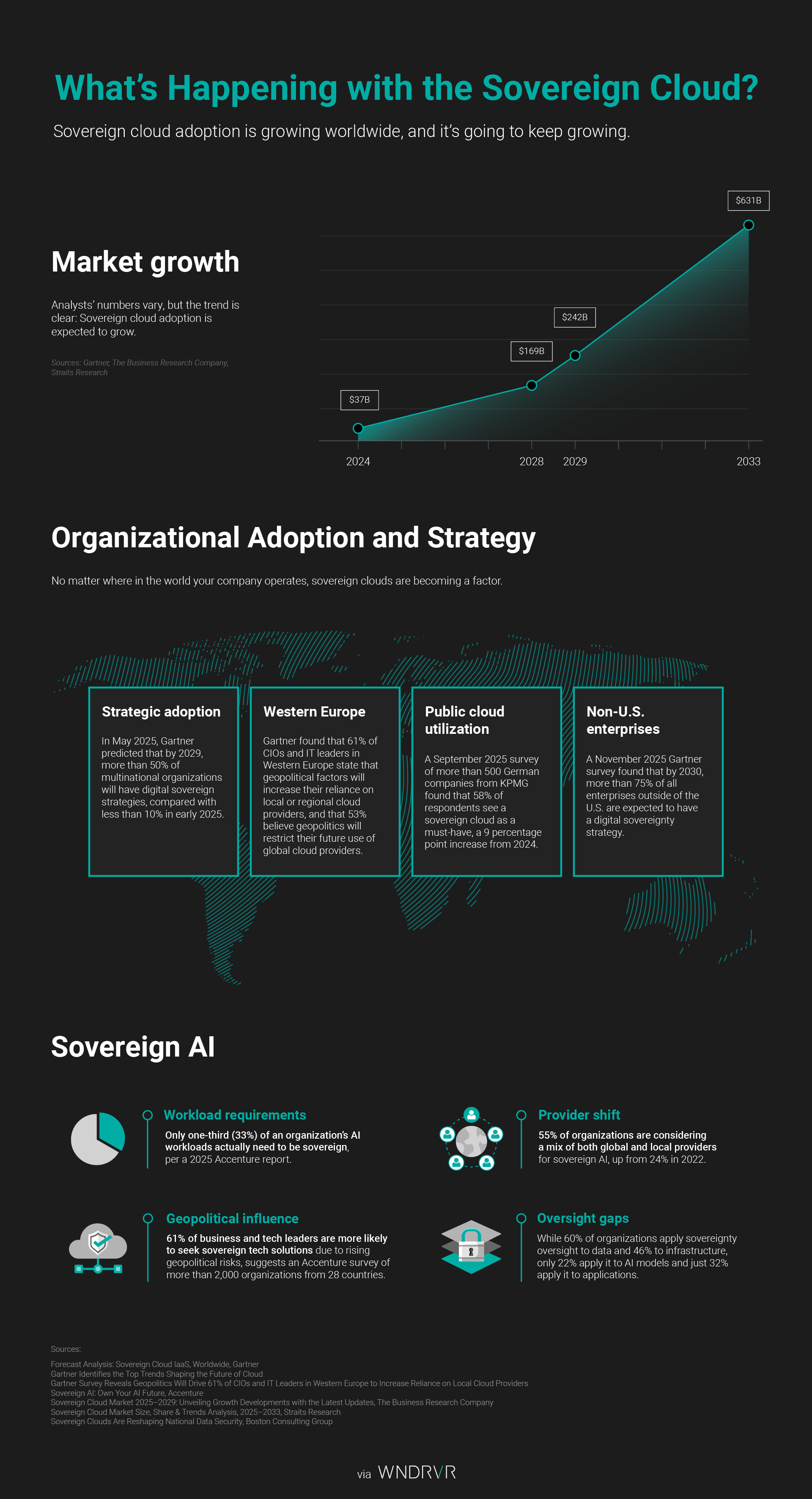
Sources:
- Forecast Analysis: Sovereign Cloud IaaS, Worldwide, Gartner
- Gartner Identifies the Top Trends Shaping the Future of Cloud
- Gartner Survey Reveals Geopolitics Will Drive 61% of CIOs and IT Leaders in Western Europe to Increase Reliance on Local Cloud Providers
- Sovereign AI: Own Your AI Future, Accenture
- Sovereign Cloud Market 2025–2029: Unveiling Growth Developments with the Latest Updates, The Business Research Company
- Sovereign Cloud Market Size, Share & Trends Analysis, 2025–2033, Straits Research
- Sovereign Clouds Are Reshaping National Data Security, Boston Consulting Group
Wind River Blog
The Wind River Blog is made up of a variety of voices: executives, technologists and industry enthusiasts. We hope to foster conversations and encourage the sharing of insights regarding the evolving landscape of intelligent, connected systems with our ecosystem of customers, partners and colleagues.
 Get our RSS feed