



Why Platform Anatomy Matters for Edge AI
Guest contributor: Olga Yashkova, Research Manager, IDC
Picture a self-driving car that identifies a cyclist obscured by a building before they reach an intersection. The vehicle stops in time to prevent a crash. That split-second save is what edge AI was built for. That applies equally well to a maintenance alert that keeps a factory line running rather than permitting a machine to fail and to an imaging system that helps a radiologist catch what the eye might miss. This perspective builds on recent IDC research on edge AI platforms and how they are reshaping operations across industries.
In my research on edge computing platforms, I keep arriving at the same conclusion: the goal isn't just faster AI. It's AI that prevents problems before they happen, whether that means avoiding a collision, catching a machine fault before it stops the line, or improving a patient's outcome.
Anatomy matters
Every industry I study has a different use case, but they all share one requirement: a platform built for continuous learning, not for the old "train once, run forever" model. Today's workloads sense and react to the real world in real time, so the data generated at the edge has to keep feeding back into the models that depend on it. Otherwise, those models degrade.
That puts real weight on the platform itself. At the edge, compute and connectivity are effectively AI's brain and nervous system. They need to run autonomously, with minimal human hands-on-keyboard time, and they need connectivity dependable enough for mission-critical work, even if the most powerful edge processor is only as useful as the network carrying its data.
Connectivity itself is getting more complicated. Edge deployments used to be a simple two-way conversation between the edge and the cloud. Now devices communicate with other devices, and cloud and core systems share data across distributed platforms in both directions. The shift requires platforms to be "distributed by design," built from the ground up to connect, secure, and make sense of resources wherever they sit.
The payoff is measurable
The organizations I talk to that have invested in edge platforms report real, measurable gains: faster decision-making, greater accuracy and precision, and reduced risk for workers on repetitive or physically dangerous tasks (see Figure 1). Real-time processing means that decisions happen without waiting for a round trip to the cloud. That speed compounds, yielding faster responses to changing conditions, more consistent quality on the factory floor, and more precise healthcare diagnostics.
Three trends worth watching
The research identified three trends worth watching:
- Digitally enhanced operations are accelerating. In my conversations with clients, I see more edge investments for digital business and field operations, a sign that early proof-of-concept projects are finally proving their value. The harder part now is scaling, getting from a promising pilot to a full rollout across many locations without the cost and complexity getting out of control.
- Integration remains the biggest hurdle. In IDC's Edge View Survey, conducted in January 2025, 83% of enterprises across various industries said they need edge partners that can integrate with their existing core and cloud environments. In addition, 81% wanted a guarantee that all the components work together. That's not a small ask: every industry I look at dedicates real time and cost, a substantial share of a project's budget, just to getting disparate systems to talk to each other.
- Life-cycle management is moving to center stage. Edge AI isn't a one-and-done deployment. Data is generated at the edge, aggregated centrally to retrain models, and redeployed back out, continuously. In regulated industries especially, that loop means security and governance cannot just cover data at rest; they have to hold up at every stage of the cycle.
None of this makes edge AI simple. But it does make the platform choice one of the most consequential decisions an IT organization makes this year. The winners will be those who treat platform anatomy — how compute, connectivity, and data management fit together — as a strategic question, not an afterthought.
FIGURE 1: Benefits of Edge Investments
Q. What did your organization gain from edge investment?
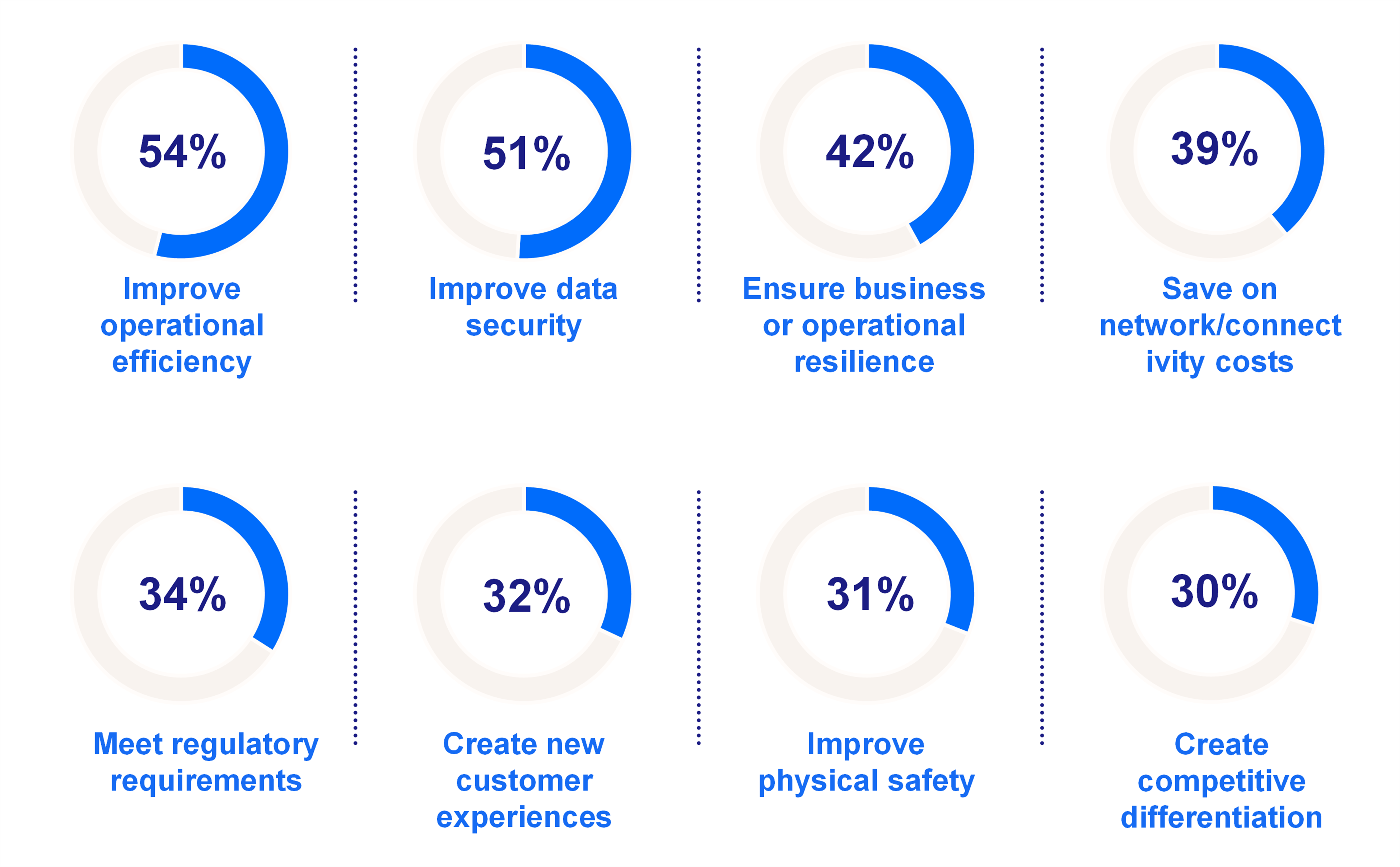
n = 800
Source: IDC's Edge View Survey, January 2025
Message from the Sponsor
Wind River provides software platforms that enable deployment and lifecycle management of edge AI workloads. With more than four decades of mission-critical experience across industrial and other sectors such as manufacturing, healthcare, aerospace, defense, telecommunications, and retail, Wind River spans the continuum from embedded systems to enterprise infrastructure, including Wind River Cloud Platform, eLxr Pro, Wind River Linux, VxWorks, Helix, and Wind River Analytics and Conductor. Learn more about building a distributed-by-design edge AI platform at Wind River Edge AI.
Wind River Blog
The Wind River Blog is made up of a variety of voices: executives, technologists and industry enthusiasts. We hope to foster conversations and encourage the sharing of insights regarding the evolving landscape of intelligent, connected systems with our ecosystem of customers, partners and colleagues.
 Get our RSS feed