



Three Ways Studio Testing Suite Improves Embedded Software Validation
One of the oldest frustrations in embedded software development is needing to test software on hardware that isn’t available. Sometimes the situation is even more frustrating: The hardware is available, but it is not yet ready to use.
The situation is like arriving at the airport and seeing the plane at the gate. The plane is there, but that doesn’t mean it’s fueled, boarded, cleared for takeoff, or ready to fly.
The same challenge exists in embedded testing. A developer may reserve a test target, only to discover the device needs to be flashed, rebooted, recovered, or manually prepared before testing can begin. These delays create hardware bottlenecks that slow validation, disrupt development schedules, and pull engineering teams away from what they should be focused on: delivering high-quality software.
That’s why the latest Wind River Studio Testing Suite focuses on reducing the operational overhead surrounding software validation. Whether it’s using AI agents to orchestrate complex workflows, automating the lifecycle of physical test hardware, or scaling automation across existing test frameworks, this release helps teams spend less time managing infrastructure and more time validating software. Here’s what sets it apart.
It uses conversational AI agents for testing
The hardest part of testing embedded systems shouldn’t be getting started.
Too often, embedded software teams spend more time preparing to test than actually testing. Before the engineers can begin a software validation run, they may need to locate available hardware, reserve resources, prepare environments, and coordinate execution steps across multiple tools. To automate the tasks, teams frequently build and maintain their own scripts, which creates additional complexity and opportunities for error.
Studio Testing Suite changes the dynamic with Model Context Protocol (MCP) server integration. Developers and testers can interact with Studio Testing Suite based on the intended outcome rather than manually defining every step to get there:
- Intent-driven execution: Stop writing custom sequencing logic. Simply state the desired outcome, such as, “Run regression testing on available ARM targets.” Studio Testing Suite handles target discovery, reservation, environment prep, monitoring, and teardown.
- Human-readable insights: Say goodbye to digging through complex raw YAML or JSON files. Studio Testing Suite automatically translates machine logs into instant, human-understandable summaries detailing reservation statuses, target connectivity, and clear failure root causes.
- Enterprise-grade control: Enjoy AI-powered workflow automation without sacrificing security, governance, and predictability.
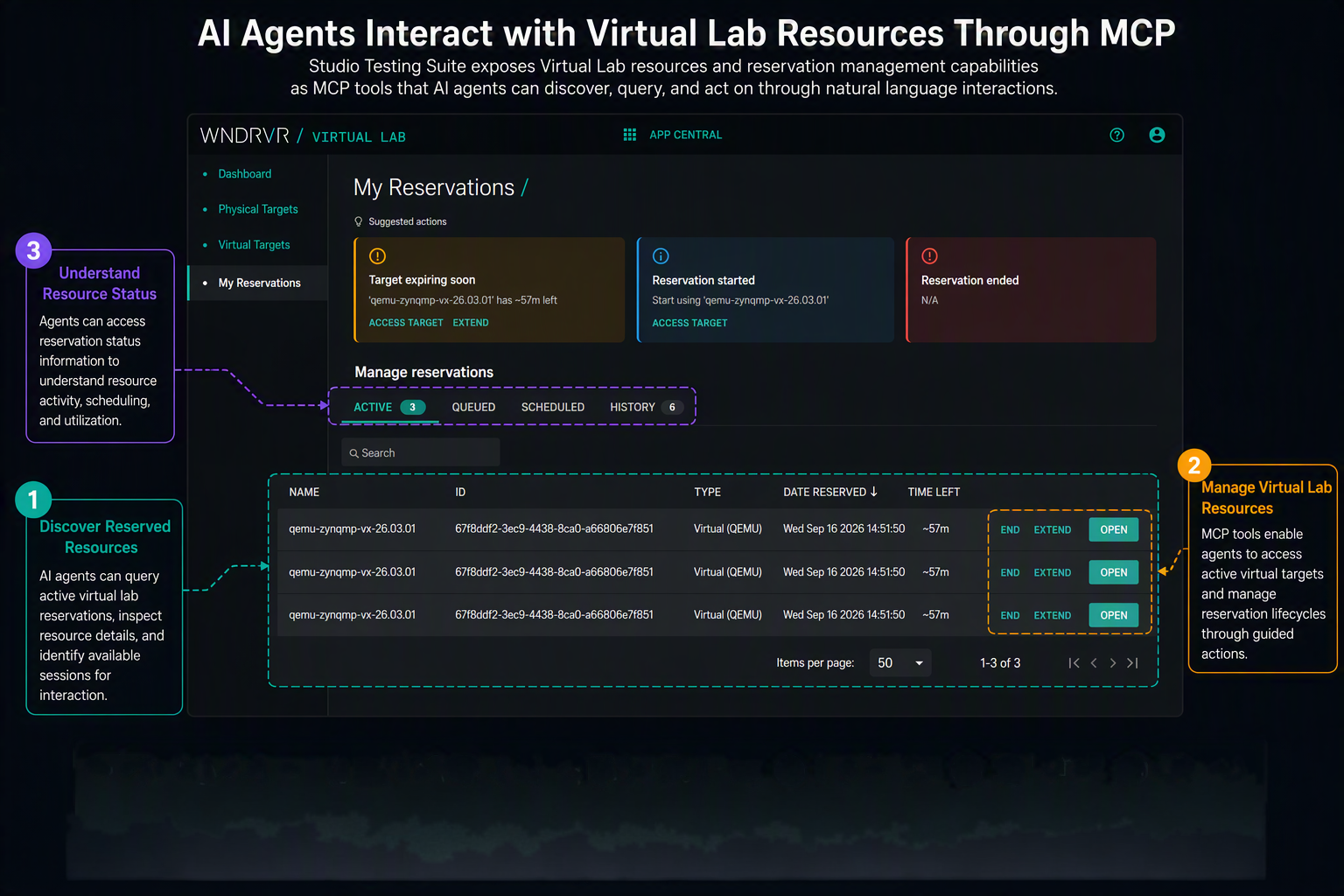
Shifting cognitive overhead tasks to the agent can free up time to focus on innovative solutions that create value — otherwise known as “the fun stuff.” Spend less time managing how testing happens and more time on getting results.
It automates management of physical targets
When a product is ready to test, the last thing an engineer wants is to spend the morning troubleshooting hardware. Yet that’s exactly what happens in many cases. Test targets need manual recovery, re-flashing, or rebooting before anyone can use them. Instead of validating software, developers end up managing infrastructure.
Studio Testing Suite removes that friction by automating how teams prepare, control, and recover physical targets:
- Closed-loop hardware control: Trigger automated target re-flashing, reboots, and power cycles directly through scripts, CI pipelines, or AI agents to recover hung targets instantly without pulling plugs in the lab.
- Centralized hardware control: A single interface manages target reboots and power cycles across distributed lab equipment.
- Guaranteed availability: Developers can kick off tests with confidence, knowing their assigned physical target is recovered, flashed, booted, and ready.
The result? Less time spent troubleshooting test infrastructure. More time spent being productive.
It brings existing test scripts into Studio Testing Suite
Developers spend years building test scripts, frameworks, and workflows customized for their products and platforms. But as the applications grow across teams and environments, they can become fragmented and harder to track. Testing operations become difficult, affecting visibility, governance, and traceability. Nobody wants to revisit everything in the test suite, but sometimes it feels like the only answer.
Studio Testing Suite addresses this challenge with Test Automation Extensibility, which brings existing test scripts directly into Studio, including custom VxWorks, Wind River Linux, and proprietary customer setups.
- Zero rework required: Protect past automation investments by bringing current test frameworks directly into Studio without rewriting scripts.
- Centralized visibility: Consolidate quality metrics, compliance reporting, and end-to-end traceability across all platforms into an easily understood dashboard.
- Scalability, the way it should be: Standardize governance across all teams while dramatically improving framework resiliency.
Instead of choosing between maintaining existing investments and improving scalability, developers can build on the automation they already depend on.
Simplify what matters most
Together, these enhancements address three major sources of testing overhead: orchestrating complex workflows, keeping physical hardware ready for execution, and scaling automation across existing frameworks.
Studio Testing Suite brings together these capabilities to help embedded software developers validate software faster and better, improve operational efficiency, and gain greater confidence in their software.
Ready to simplify embedded software testing? Get started with Wind River Studio Testing Suite.
Wind River Blog
The Wind River Blog is made up of a variety of voices: executives, technologists and industry enthusiasts. We hope to foster conversations and encourage the sharing of insights regarding the evolving landscape of intelligent, connected systems with our ecosystem of customers, partners and colleagues.
 Get our RSS feed