



TTTECH and Wind River to Collaborate on HPSC Development
TTTech Aerospace and Wind River Systems are teaming up on a tech stack for NASA’s HPSC-class computers, space‑grade Linux deployments, and future ARINC‑664 Part 7 Rev A Integrated Modular Avionics (IMA) networks.
For decades, spaceflight computing has been constrained by processors that trail commercial technology by years or even decades as mission requirements continue to grow. The latest missions demand autonomy, advanced payload processing, artificial intelligence, and increasingly complex software architectures.
NASA’s High-Performance Spaceflight Computing (HPSC) initiative aims to address those challenges, and both Wind River and TTTech Aerospace are doing their best to make the effort a success.
TTTech and Wind River have spent decades addressing flight requirements from opposite ends of the technology stack. TTTECH provides deterministic embedded network IP platform solutions for aviation and space applications and has built deterministic Ethernet backbones for safety‑critical networks. Wind River has employed its aerospace expertise to build the operating systems, file systems, network stacks, and tools that live on every major processor in flight and space.
The new backbone
Next‑generation space missions are converging on a common architecture pattern: high‑performance multicore processing (HPSC and its peers), space‑grade Linux and real-time operating system (RTOS) partitions, and mixed-criticality deterministic Ethernet capable of carrying everything from flight‑critical data to noncritical payload information.
Program offices want:
- An HPSC‑class compute environment that runs both hard real‑time and Linux workloads
- A deterministic network backbone that safely hosts mixed‑criticality traffic
- High technology readiness level (TRL) hardware and software
TTTech and Wind River sit exactly at that intersection: One provides the deterministic network fabric while the other offers the space‑qualified RTOS, virtualization, and space‑grade Linux that can exploit HPSC.
TTTECH: Deterministic Ethernet and ARINC‑664 p7 Rev A for space and IMA
TTTech has become synonymous with deterministic Ethernet in aviation and space technologies. Its TTEthernet® technology blends standard Ethernet, ARINC‑664 Part 7, and AS6802 fully time‑triggered traffic on a single wire, with design and verification tools tailored to IMA architectures. TTTech was a founding member of the IEEE 802.1 Time-Sensitive Networking Working Group and offers a variety of TSN switch and end-point solutions for aviation and space applications.
TTTECH also offers integrated radiation‑hardened end‑system and switch controllers and complete deterministic Ethernet networks. These products are currently entering series production for human‑rated and robotic missions ranging from low-earth orbit to deep space.
Wind River: VxWorks, HVP, and space‑grade Linux for HPSC
Wind River brings the software foundations, with decades of history with NASA and European Space Agency missions. VxWorks® has been the RTOS of record for numerous deep‑space probes, landers, and rovers. For mixed‑criticality platforms, Helix™ Virtualization Platform (HVP) lets engineers run VxWorks and Linux (and third‑party guests) on a single multicore system-on-chip under a safety‑certifiable hypervisor. That’s an ideal match for HPSC‑style systems.
Wind River is actively engaged in making Linux a first‑class citizen in space. Through its work in initiatives like Space Grade Linux and broader safety‑critical Linux efforts, Wind River is hardening Linux kernels, configurations, and tooling so they can host payload apps, autonomy stacks, and data‑processing workloads alongside RTOS partitions.
The result is a continuum: VxWorks for hard real‑time control, space‑grade Linux for high‑throughput and AI, and HVP to bind them together with strong partitioning on HPSC systems.
Previous collaborations
TTTech and Wind River have jointly delivered mission-critical technologies through countless successful integrations. Among them are TTTECH’s TTE‑End System driver intellectual property, and software integration with VxWorks across a broad set of processors and boards.
Today, the TTE-Driver, TTE-COM, and TTE-Sync middleware run on:
- PowerPC 603/750 and e500/e500v2/e500mc/e5500 families
- SPARCv8/LEON4 (e.g., GR‑740)
- Arm® Cortex‑A72 on HVP for Versal‑class devices
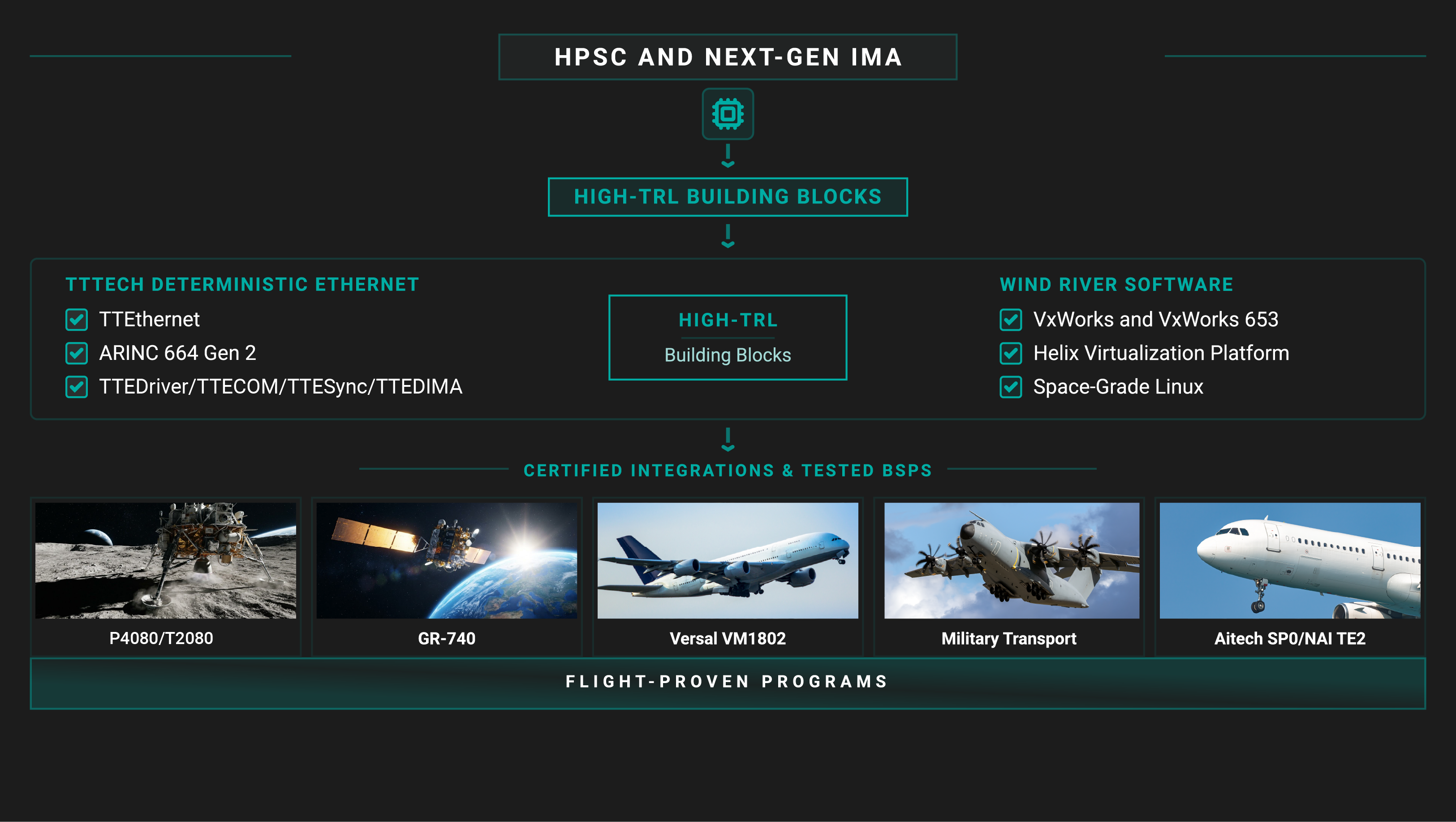
Those stacks have been exercised on different types of hardware platforms, such as:
- Development systems: WR SBC 7557, WR SBC 750, MPC8349E‑mITX, NXP P4080-DS, NXP P5020-DS, NXP T2080-RDB, P3041, GR-CPCI-GR740, AMD VMK180, AMD VCK190
- Commercial off-the-shelf single-board computers: X-ES XCalibur164x, X-ES XCalibur1900, CES Rio6‑8093TF, CES RIOV‑247x, NAI 68PPC2, AiTech SP0-S, Curtiss-Wright VPX3-133, BAE RAD750, BAE RAD5545
- Custom computers: custom MPC8349E, custom P2020, custom T2080, custom GR-740, custom MPC8548E
TTTECH’s own line of ruggedized and space hardware products demonstrate ARINC‑664 p7/TTEthernet traffic patterns on those platforms, giving users something rare in space: proven, repeatable, high‑TRL building blocks.
YAML‑driven integration
One subtle advantage of this proven tech stack is how cleanly configuration can flow from TTTECH’s deterministic Ethernet tools into Wind River’s operating system environments.
VxWorks has adopted a YAML‑based configuration model for many aspects of system setup. YAML is a human-friendly data serialization language for all programming languages. Networking, time partitioning, and I/O can be expressed as structured YAML instead of as opaque, hand‑coded tables. That aligns naturally with TTTECH’s design tooling for TTEthernet and TSN networks.
Schedules, virtual link definitions, traffic classes, and partition mappings that are designed and analyzed in TTTECH’s GUI-based configuration environment can be exported into XML and easily further post‑processed into YAML. The YAML code feeds directly into VxWorks and HVP builds. Instead of manually rekeying complex configuration tables, integrators can script a path where TTTECH’s tools capture and validate the deterministic network design, automation converts key artifacts into YAML fragments, and then VxWorks/HVP ingest those YAML fragments to configure end‑system drivers, network stacks, and partitions.
This reduces integration effort, lowers the risk of transcription errors, and creates a clear trace from the certified network design into the deployed software image. That’s exactly the kind of traceability auditors expect on high‑assurance programs.
Ethernet/TSN/TTEthernet: A Decade‑Long Investment
Both Wind River and TTTECH have invested heavily in the broader ecosystem around deterministic networking. TTTECH’s TTEthernet and TSN products enable mixed‑criticality networks in commercial and military avionics, as well as in major space programs. Wind River has committed to TSN across VxWorks, HVP, and Wind River® Linux, standardizing on converged Ethernet as the backbone for control and payload data.
Joint and adjacent efforts — such as TSN‑enabled VxWorks deployments with specialized TSN partners, or Wind River’s support for TSN in edge and automotive systems — feed directly into IMA and space missions. They give integrators confidence that the Ethernet stack underneath their TTEthernet and TSN networks is actively maintained, standards‑compliant, and optimized for real‑time behavior — not just “good enough” for enterprise traffic.
TTTECH plus Wind River is the ‘go‑to’ stack
When it’s all put together, the value for primes, agencies, and integrators looks like this:
- High TRL by default: Proven integrations across multiple VxWorks generations, processors, and boards mean that integrators start from flightlike configurations, not a greenfield R&D exercise.
- End‑to‑end determinism: TTTECH’s deterministic TSN and TTEthernet networks combined with VxWorks/HVP partitioning support provide control over both temporal and spatial behavior.
- HPSC‑ready software: VxWorks, Helix, and space‑grade Linux help integrators exploit HPSC and similar multicore platforms for real‑time control and high‑throughput data processing.
- Smooth toolchain integration: YAML‑based VxWorks configuration and mature TTTECH network-configuration tools enable a scripted, traceable path from network design to deployed images, reducing schedule and integration risk.
- Future‑proof Ethernet: Years of collective investment in TSN, TTEthernet, and ARINC‑664 Part 7 Rev A mean that the same vendors that help systems integrators field current missions are aligned with the next wave of standards.
Future spacecraft need to process more data, make more decisions autonomously, and support increasingly complex software ecosystems. Achieving that vision requires more than a powerful processor. It requires a proven stack spanning operating systems, virtualization, deterministic networking, and integration tools.
By combining TTTECH’s deterministic networking technologies with Wind River’s leadership in real-time operating systems, virtualization, and space-grade Linux, the industry gains a foundation for the next generation of mission-critical space computing.
The future of space computing is converging around mixed-criticality multicore architectures, and TTTECH plus Wind River provides one of the industry's most mature, flight-ready technology stacks for making that transition.
Explore how Wind River, together with partners like TTTECH, uses HPSC and TSN to enable next-generation mission-critical architectures, or speak to a salesperson at Wind River or TTTech.
Wind River Blog
The Wind River Blog is made up of a variety of voices: executives, technologists and industry enthusiasts. We hope to foster conversations and encourage the sharing of insights regarding the evolving landscape of intelligent, connected systems with our ecosystem of customers, partners and colleagues.
 Get our RSS feed