


O-RAN Plugfest Highlights AI-driven, Traffic-aware Software Improving Autonomous Network’s Energy Efficiency Up to 12%
At the Fall 2026 O-RAN Global PlugFest, Wind River presented the results of closed-loop energy optimization at the cloud infrastructure layer for an Open RAN (O-RAN) site of a mobile operator customer. For its first three months of testing, the site – based on a live O-RAN traffic pattern – has experienced no service disruption. The AI-based system is still running, without the touch of human hands.
This proof of concept was performed on real-world hardware, not in a lab environment. Wind River re-created actual traffic patterns from existing telco systems and trained an AI model to manage them.
The presentation demonstrated that Wind River’s AI-driven, traffic-aware software energy profiles cut energy usage by up to 12%, compared with a baseline server without a software energy profile.
Energy is the proper first use case
Communication service providers (CSPs) are under pressure on several fronts with two critical issues at the top: rising radio access network (RAN) energy bills and commitments to cut their carbon footprint. At the same time, many are cautious about letting AI take actions in their live networks.
Energy efficiency sits at the intersection of both concerns, with properties that make it an ideal starting point for autonomy:
- Measurable outcomes. Power draw goes down or it does not. The change can be seen per node, per core, and per pod.
- Bounded and reversible actions. As demonstrated in the conference session, Wind River can dynamically switch a CPU energy profile with specific non-application-affecting parameters (e.g., C-state) and switch it back if circumstances require it.
- Clear service requirements. There is no service disruption: no packet drops, no application downtime, and no latency introduction. Any failure is an immediate signal to revert.
- Compounding value. Savings accrue every hour of every day across thousands of sites, all from a single software change.
If telecom can get this use case right, CSPs will gain more than lower energy costs. They’ll gain trusted, AI-powered, closed-loop automation that can extend to other autonomous network use cases.
A practical demonstration
The architectural challenge for autonomous networks is not building smarter models. It is reliably turning a probabilistic AI recommendation into a safe, policy-driven action at the infrastructure layer.
AI excels at spotting patterns and learning from large data volumes, including O-RAN live network traffic. Getting a RAN site to act on those patterns safely and automatically is more difficult. Energy efficiency, aided by AI technologies, addresses that problem.
A typical RAN/cellular site is sized for worst-case scenarios: the busiest hour of the busiest day. Yet, it runs far below that peak for most of the day. An AI model that watches CPU, memory, and network telemetry can determine with high confidence when traffic is falling and then run the site in a lower power state.
That insight is only the first step. Someone, or something, has to change how the platform behaves underneath real-time RAN workloads, such as the O-RAN central unit (O-CU) and O-RAN Distributed Unit (O-DU). And it must do so without disrupting customer services.
If that change happens at the wrong moment, the cost is more than a slightly higher energy bill. A misplaced adjustment could degrade service for customers, which would lead to a loss of trust in automation. And that could be a significant setback for the AI programs of operators and CSPs.
Closing the loop: From AI insights to safe actions
Wind River built a closed-loop energy efficiency proof of concept (POC) for the Fall 2026 O-RAN Global PlugFest. Together with a mobile network operator (MNO) customer, Wind River created an O-RAN mirror lab, including live O-RAN network traffic and usage patterns. The lab consisted of two O-RAN sites in which Wind River simulated O-DU and O-CU workloads with traffic and stress generators in accordance with the telco’s live O-RAN network pattern. These workloads ran on Wind River’s container-as-a-service (CaaS) platform. The traffic pattern was replayed into line-rate fronthaul and backhaul traffic generators, as well as CPU and memory stress generators that aligned the traffic pattern.
The traffic pattern trained the AI model in Wind River Analytics for its AI insights. Additional CPU and memory stress and traffic anomalies were injected to trigger the closed loop using Wind River Conductor, as shown in Figure 1.
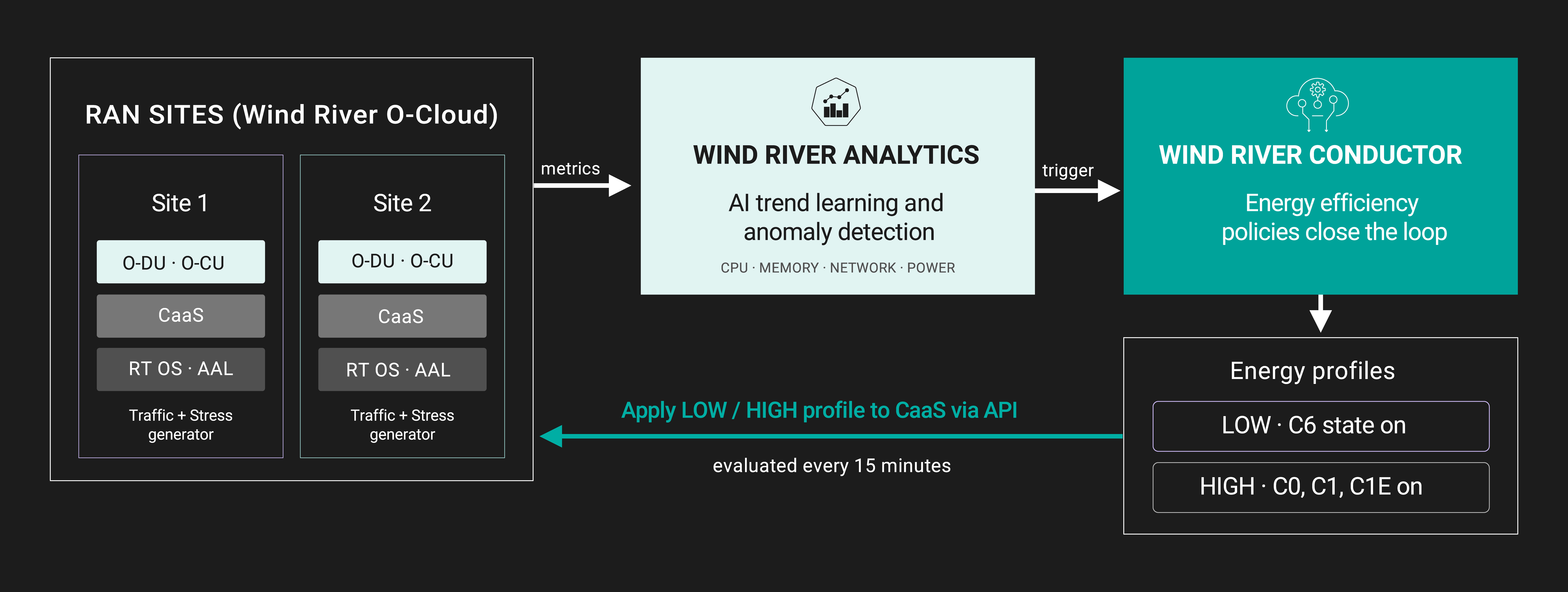
Figure 1. Wind River Analytics turns telemetry into an AI-driven trigger. Wind River Conductor applies a policy-defined energy profile to the O-Cloud CaaS layer using APIs.
The division of labor is deliberate. Wind River Analytics does what AI does well: It learns traffic and usage trends and flags when and how the site traffic and/or usage pattern deviates. Wind River Conductor does what automation must do reliably: It applies a known, tested energy profile that follows user-defined action policies, which include user-defined guardrails and oversight of the AI’s actions. The AI recommends, CSP guardrails direct, and policy-driven orchestration acts.
The proof of concept used two software energy profiles at the CaaS layer:
- A low-energy profile, with the deep CPU C6 sleep state enabled, for low and normal traffic
- A high-energy profile, with C0, C1, and C1E states enabled, for high traffic
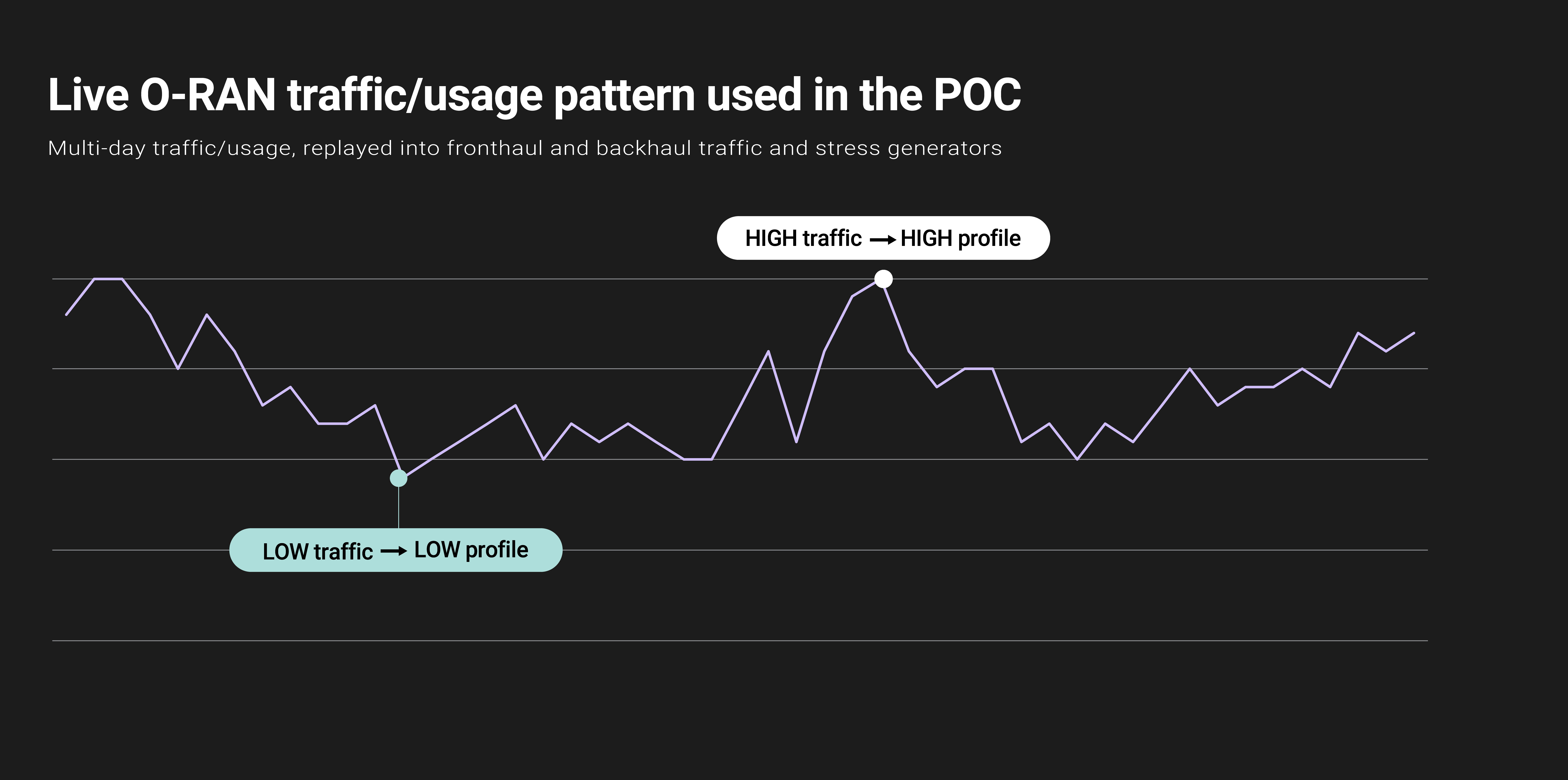
Figure 2. The POC’s live traffic pattern was based on peak holiday season. Peaks are short; most of the day is spent at low or normal load, which is exactly where software energy savings are largest.
Over more than three months of testing, the closed loop delivered software energy savings with no packet drops and no application downtime. Savings were measured against a baseline site that ran without a software energy profile.
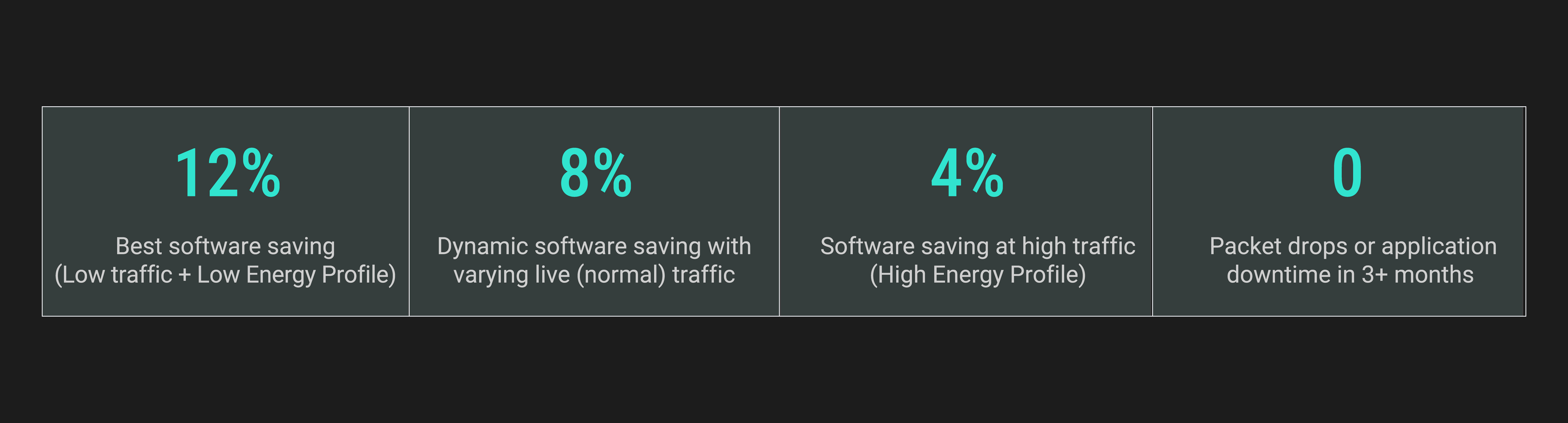
Three findings stood out. First, the correct profile depends on the traffic/usage load. It is comparable to using the right gears in a car; a high gear is needed for maximum speed. As such, the low-energy profile saved 12% with low traffic and 8% with normal, varying live traffic, as shown in Figure 2. The high-energy profile saved 4% with high traffic, matching the high-performance workload requirement.
Second, choosing a wrong profile has an efficiency cost. Under high traffic, the low-energy profile worked against normal system operation and increased energy use by 6%. Switching to the high-energy profile turned that into a 4% savings. Being energy efficient is not about always running in the lowest power state. It is about running in the right state for the workload at that moment.
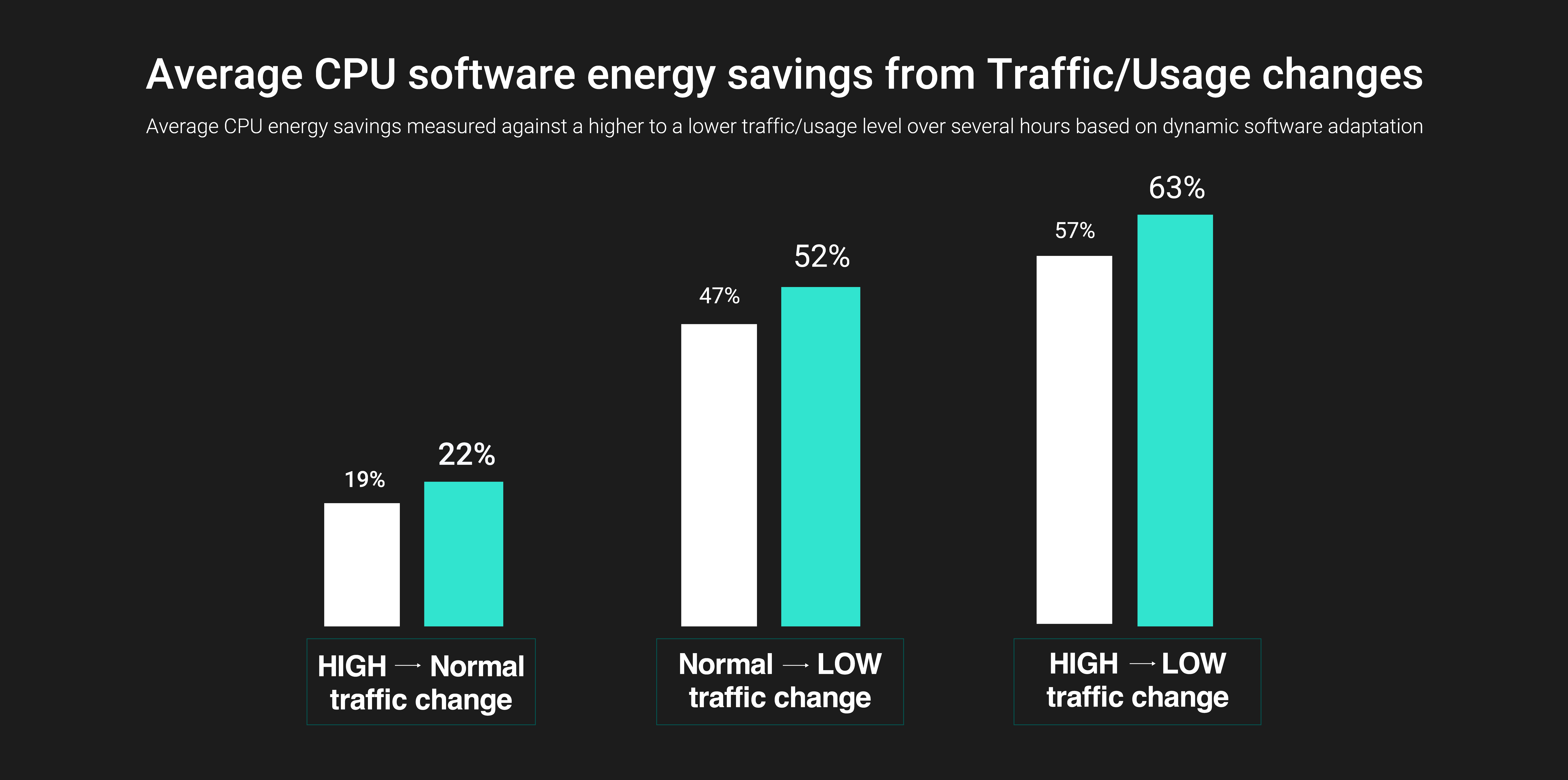
Figure 3. The average CPU energy savings as live traffic pattern changed in the POC. Dynamic software adaptation provides high CPU energy savings as the traffic moves from high to lower traffic/usage levels.
Third, software today controls parts of the commercial-off-the-shelf server, namely the CPU, which is the large power-consuming component. While it isn’t possible for the AI-driven software to control everything in the server, one adjustable element is CPU settings. As Figure 3 shows, the analytics software adjusts the CPU dynamically to respond to traffic changes. A drop in traffic or usage levels using a low-energy profile achieved up to 63% CPU energy savings.
Savings do not come from a single clever setting. They come from choosing the right profile for the right traffic at the right time, automatically.
Learning from traffic- and usage-aware, AI-powered software
The POC surfaced practical lessons for anyone building AI-driven automation in live networks:
- Guardrails come first. Operators are more comfortable letting the loop run on its own in an automated fashion when the system starts with the human experience, such as defining what safe means (no packet drops, no downtime, no disruption).
- AI learning must be right-sized. Traffic patterns shift over days, weeks, and months. Training on chunks that are too small misses the trend; training on chunks that are too large over-learns and misses real anomalies.
- Traffic is not the only signal. In deciding when to change energy profiles, the application resources used, including CPU and memory, are as important as traffic volume.
- Power savings is an incremental payoff. The energy savings demonstrated improves assets’ ROI or payback, because the telco saves money while the RAN sites’ mobile subscribers encounter no disruption.
What comes next
Energy profiles based on C-states are a starting point, not the end. Early observations suggest that combining C-states with P-state control and lower uncore frequencies could unlock further savings.
Wind River identified the following next steps for the telecoms industry:
- Validating additional CaaS energy parameters, such as P-states and uncore
- Advancing standardization of closed-loop energy efficiency in the O-RAN and AI-RAN Alliances
- Applying the same AI, policy, and guardrail pattern to other autonomous network use cases
Autonomous networks will not arrive in one leap. They will be built use case by use case, each one earning operators’ trust. Energy efficiency is the natural first step. The value is measurable, the actions are bounded and reversible, and the outcomes are clear.
Members of Plugfest can watch the entire presentation online.
Learn more about Wind River for 5G and O-RAN and AI-RAN.
Glen Ragoonanan is technical leader for Wind River’s EMEA telco segment leading a team of experts in cloud platforms, analytics, orchestration, and AI-driven network automation.
Nandanandan Mishra is the solutions architect for Wind River’s EMEA telco customers, representing the Wind River Private Cloud Suite and AI product lines. With more than 15 years of experience in cloud infrastructure and networking, he helps telecom operators design and deploy Kubernetes-based private cloud platforms across Core and RAN.
Wind River Blog
The Wind River Blog is made up of a variety of voices: executives, technologists and industry enthusiasts. We hope to foster conversations and encourage the sharing of insights regarding the evolving landscape of intelligent, connected systems with our ecosystem of customers, partners and colleagues.
 Get our RSS feed