


Finding opportunity in the challenges facing industrial automation
Industrial process automation poses requirements that businesses can meet with the support of a strong partner ecosystem and DevSecOps systems.

The industrial sector, with its increasing use of robotics, artificial intelligence (AI), and other new technologies, is undergoing a rapid evolution. Grand View Research’s recent “Industrial Automation and Control Systems Market Size, Share & Trends Analysis Report” anticipates that the industrial automation and control systems market will grow at a CAGR of 10.5% by 2030. As industries increasingly embrace process automation, whether to chase opportunity or meet the need to compete — or both — it becomes clear that the very factors that increase efficiency and reduce costs can also create complex challenges. Recently we spoke with Thomas Rosén, vice president of EMEA sales at Wind River®, to learn more about the common themes, challenges, and opportunities that industry currently faces in the realm of automation. We’ve consolidated his main points below.
SIX FOCAL POINTS
Industries in the process automation domain currently are primarily concentrating on several objectives and related challenges.
1. Efficiency improvements and cost reductions
The race is on to reduce development time and use fewer resources, and at the same time to reduce operational costs through automation and various optimizations.
2. Quality improvement
There is a need to improve quality in these deployed products and solutions, ultimately because the cost of fixing problems late in the R&D cycle, or even post-deployment, increases exponentially. At the same time, the complexity of these automation systems has been increasing and continues to increase a lot. All the clients I met over the last year have been focusing on improving quality. Meanwhile they face increasing complexity and the need to reduce time-to-market as they are challenged by startup and scale-up organizations that don’t have the brownfield to consider — they can start from scratch.
3. Scalability and flexibility
There are really two dimensions to this. First, you have the market requirement to add new, incremental, updated functionality to your existing fielded systems. Second, you have the ability to scale your system from low end to high end to address various markets. So our clients have sometimes operated in silos when it comes to developing their products, and they’ve ended up not being able to reuse software across multiple product families.
That’s a huge problem and challenge for them. As a example, in the programmable logic controller (PLC) market, typical PLC suppliers have a range of products scaling from low-end, low-cost — perhaps suitable for building in automation — through high-end PLCs — useful in industrial use cases such as chemical plants, oil rigs, and so on. Lastly, there is also a trend to push PLC control functionality into the cloud, onto some kind of edge cloud, which typically is installed on-prem — on a centralized server or even a mini data center in the factory, plant, or whatever.
4. Cybersecurity
There is obviously a big concern in the process automation domain, just as in the larger society, about cybersecurity. Protecting these automated systems from cyberthreats is a significant challenge. Earlier this spring, the European Parliament put in place the Cyber Resilience Act, which will be enforceable by 2027. This is a complex regulatory framework aiming to enhance cybersecurity across the European Union. So all clients in the process automation space are probably asking themselves whether they have a CRA-compliant story across their product portfolio.
Another interesting aspect when it comes to this, and when it comes to security in general, is that you need to consider security by design. Security is not something that you can bolt on afterward. So the whole development process needs to consider and implement various security measures through the entire product development cycle, including post-deployment and lifecycle management. This includes considering how to deal with security fixes posed by, for example, common vulnerabilities and exposures (CVEs). And that requires an efficient way to update systems in the field with minimal disruption to the live systems.
5. Safety and compliance
In order to meet and address the aforementioned objectives and challenges, there is an increased focus on adhering to industry standards and meeting various industry regulations. This process is pretty complex and time-consuming. Ultimately it can lead to missed market opportunities, if you’re not able to meet those industry standards and regulations.
6. Innovation
In an increasingly competitive market, everyone needs to focus their scarce resources on value-add product development. And to my previous point, on offering flexibility, there is a need to implement an approach that allows for innovation throughout the entire lifecycle of the system.
Even the systems, devices, and products that have already been fielded need to be considered. I talked to one of our customers recently who brought up two main drivers: One was improving R&D efficiency, and the other was to increase developer velocity. They obviously go hand in hand. This customer claimed that companies that have been able to put in place higher developer velocity have shown that they can grow revenue four to five times faster than the competition. That’s obviously huge.
How can that happen? Well, they hit the market much faster, and they were able to improve innovation by 50%. So a great developer experience means that teams can deliver business value — much more business value — by spending less time on internal processes and more time on building out capabilities for their customers.
The key to making that happen is to have a clear and secure path of deploying high-quality software directly to your end customers.
TRENDS OF INTEREST
One obvious trend that everyone across society is talking about right now is AI. The vertical process automation industry is no different.
Now, I talked earlier about startups and scale-ups challenging the big incumbents of this market. There are tons of these startups, and they’re developing all these AI-based solutions to optimize things like production, to prevent anomalies and reduce human intervention.
And I said that these startups and scale-ups naturally put a lot of pressure on the market leaders. Just to give you an idea of what’s going on in the market when it pertains to innovation, let’s look at computer vision. That’s something that a lot of these process automation companies are putting effort into: being aware of the surroundings and the environment, object recognition, temperature monitoring.
Another thing is obviously preventive maintenance, being able to fix the problem before it happens. That can save a lot of money.
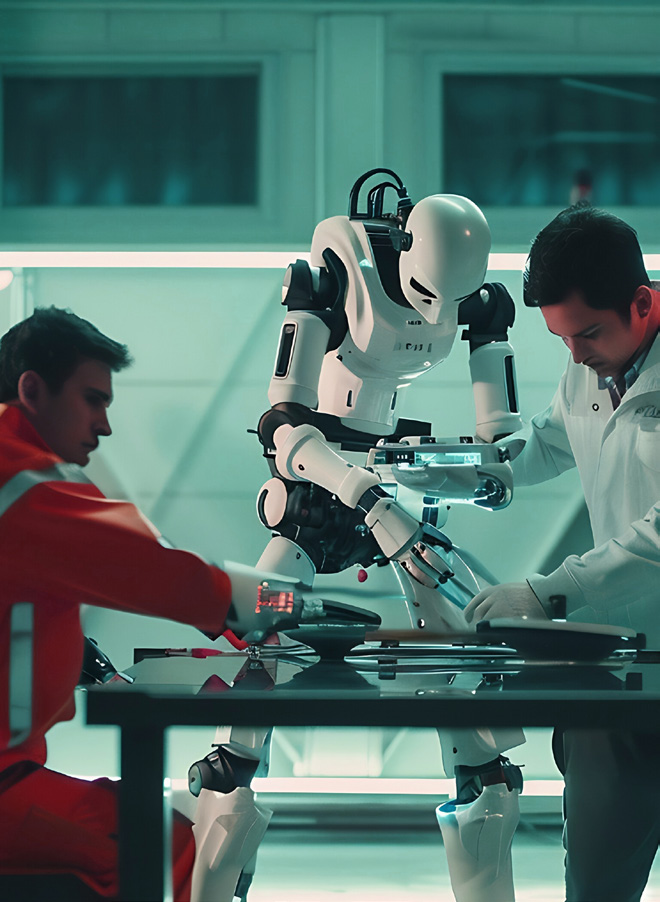
Yet another interesting trend we see is cobots. Those traditional long lines of robots on the factory floor are not only what we’re looking at; the factory floor of today includes humans and robots, so-called cobots, working side by side.
All of this is enabled by disruptive new technologies, such as 5G for connectivity on the edge and in the cloud, compute on-prem in the factory, and AI and machine learning (ML) to drive those efficiencies that I mentioned. These are making this market hotter than ever.
And everyone loves a bit of a science fiction, right? I remember when I was meeting with a C-level person some 15 years ago, and he told me that mobile connectivity bundled with cloud, compute, and AI/ML would enable mindblowing innovation in the near future. Well, I think the future has finally hit process automation. We have 5G with ultra–low latency and cloud-native solutions that are available for embedded systems today. AI/ML innovation and deployments are more real than ever before.
ECOSYSTEM SUPPORT
So yes, the future is here. And the Wind River approach takes two elements into consideration: the ecosystem and security.
With our business partnership ecosystem, as a company we can offer our customers connections between industries. What I mean by that is that we are serving many different markets, such as the 5G telecom market. Today we supply our technology to the world’s largest deployed Open RAN 5G network at Verizon. Our solutions are also supporting all the major telecom equipment manufacturers, such as Ericsson, Nokia, and others.
And as everything is becoming more or less connected through 5G or other schemes, we work with various front-runners in other industries to look at how we can bring those markets together with our technology and solutions. As another example, we provide scalable compute platforms, from the smallest hardware software systems all the way to the cloud. And these operating systems all come with cloud-native capabilities, over-the-air update capabilities, and digital feedback loop capabilities built in.
That means we’re providing a very flexible model. As I said, flexibility and scalability are more important than ever, and we can help our clients on this journey through the development phase, deployment phase, and management phase.
DEVSECOPS SUPPORT
Today everyone is also talking about DevSecOps. Wind River Studio Developer is a modern DevSecOps platform that accelerates development, deployment, and operation management of robust, mission-critical embedded or enterprise software systems at the intelligent edge.
What does that mean for our customers? Well, it enables them to securely lower their software lifecycle costs and, at the same time, shorten their timeto-market as it pertains to development.
And also capture new revenue opportunities. As a full DevSecOps system, Studio Developer helps standardize development tooling and processes, and it increases automation through the lifecycle. It also increases the collaboration between development teams. It enables you to test earlier and more often, and it heightens visibility between the embedded edge device and the cloud system.
So we are providing a very cohesive product portfolio that allows our customers to develop once and deploy in multiple ways, running those workloads at the far edge, near edge, embedded in a device, or in the cloud.
To learn more about DevSecOps for automation, visit Wind River at www.windriver.com/studio/developer.
To find out about more industrial automation solutions from Wind River, visit www.windriver.com/solutions/industrial.

ABOUT THOMAS ROSÉN
Thomas Rosén leads the EMEA organization for Wind River and is responsible for the goto-market strategy, ecosystem development, sales growth strategy, and sales organization for the region. He possesses 30 years of business and technical experience in intelligent systems and embedded software for mission-critical markets.
In his time at Wind River, he has held multiple management positions in services, support, and sales, supporting clients in industrial, telecom, A&D, and other industries. He holds an MSc in data telecommunications and networks from the University of Salford and a BSc in computer science from Mälardalen University.