


LX2/CW1708 Intel Simics Model Virtual Platform for NXP Layerscape LX2 SoCs

The Wind River® LX2/CW1708 Intel® Simics® model provides a high‑fidelity virtual platform for NXP Layerscape LX2 series system-on-chip (SoC) platforms and Curtiss‑Wright 1707/1708 boards. Built on the Intel Simics simulation environment, the model enables software development, system validation, and debugging before physical hardware is available. By reproducing key compute, networking, memory, and peripheral subsystems of the LX2 architecture, the model allows development teams to run and test software in a controlled virtual environment without requiring access to physical hardware.
KEY BENEFITS
Reduces hardware dependency during development and testing |
Accelerates board bring‑up and platform validation |
Debugs complex system behavior with full system visibility |
Enables reproducible development environments across distributed teams |



SUPPORTED SOCS AND BOARDS
| Supported NXP Layerscape LX2 SoCs | Supported Reference Boards |
|
|
KEY SIMULATED SOC FEATURES
CORE CPU BLOCK
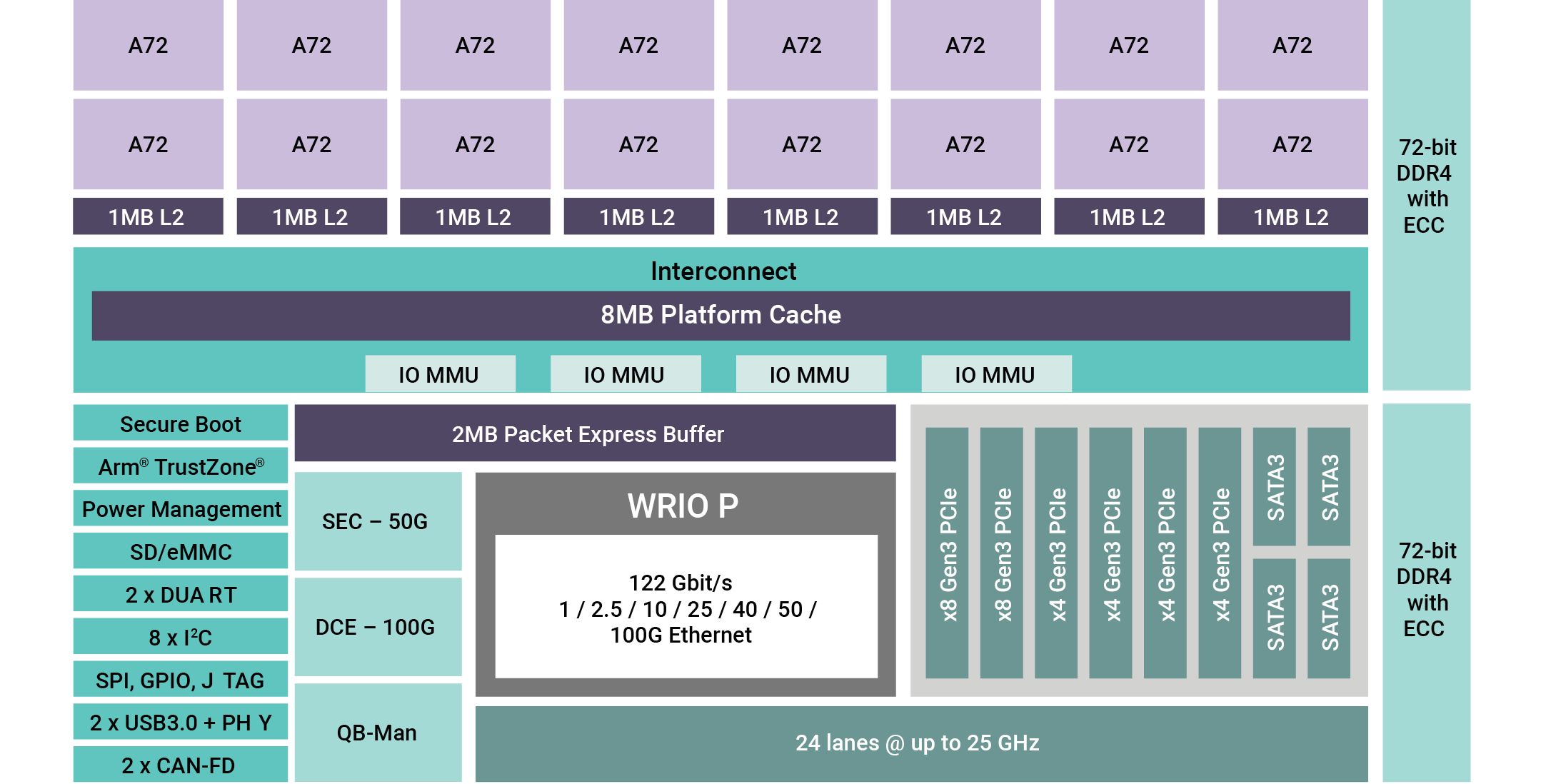
- Up to 16 Arm® Cortex-A72 CPU Cores (model-dependent)
- Up to 4 Arm TZC-400 TrustZone Controllers
- ARM CSS-600 Time Source Generator (TSGEN)
- ARM GIC-500 Interrupt Controller
- ARM MMU-500 System Memory Management Unit (SMMU)
- ARM CCN-508 CoreLink Cache Coherent Interconnect
- 2 × DDR Memory Controllers
- 2 × 128 GB DDR RAM
- 256 MB QSPI FlashROM
PCI EXPRESS BLOCK
- Up to 6 GPEX PCI Express Controllers (depending on the SoC model)
- 4 x SATA3 Controllers
DATA PATH ACCELERATION ARCHITECTURE GEN2 (DPAA2)
- Management Complex (MC)
- Wire Rate Input/Output Processor (WRIOP)
- Queue and Buffer Manager (QBMAN)
- Queued Direct Memory Access Controller (QDMA)
- 2 x 100G Ethernet Controllers (CEMAC)
- 16 x 10G Ethernet Controllers (MEMAC)
- 2 x MDIO Controllers (MDIO)
- IEEE1588 Timer
INPUT/OUTPUT DEVICE BLOCK
- Up to 2 USB3 Controllers (depending on the SoC model)
- 2 x SDHC/eMMC Memory Card Controllers (eSDHC)
- 4 x ARM PL011 Serial Ports (DUART)
- 4 x GPIO Controllers (GPIO)
- 8 x I2C Controllers (I2C)
- 3 x SPI Controllers (SPI)
- 1 x NXP SPI Controller (FlexSPI)
- 2 x NXP CANbus Controllers (FlexCAN)
- 2 x NXP Timers (FlexTimer)
OTHER DEVICES
- Pre-Boot Loader (PBL)
- Security Fuse Processor (SFP)
- Non-Secure Watchdog Timer
- Secure Watchdog Timer (TrustZone)
- Thermal Monitoring Unit (TMU)
DPAA2 SIMULATION NOTES
The DPAA2 subsystem relies on NXP’s proprietary Management Complex (MC) firmware and its associated high-level APIs. The LX2 Intel Simics model simulates DPAA2 functionality primarily through the public MC API rather than full hardware emulation of the MC processor. The current implementation uses the MC API (as documented in the DPAA2 User Manual Rev. 53), which is compatible with MC firmware version 10.38.x. APIs or DPAA2 objects introduced in newer MC firmware versions may require additional implementation.
Simulation coverage of key DPAA2 components includes:
- MC — simulated at the public API level
- WRIOP, QBMAN, QDMA — fairly complete simulation
- SEC — limited simulation; some register-level interfaces present, but core functionality (e.g., encryption/decryption, job rings) is not implemented
- MEMAC and CEMAC — complete simulation
DPAA2 configuration in the model is performed through Intel Simics scripting during workload initialization rather than through native MC firmware configuration. As a result, the configuration may vary, depending on the software environment, and new workloads may require additional configuration of the DPAA2 simulation environment.
NETWORKING SUPPORT
Because DPAA2 networking functionality is limited in the current model implementation, networking can also be enabled by attaching a generic Intel® e1000 Ethernet controller model to a PCI Express slot within the simulated LX2 platform. The E1000 device models provided with Intel Simics are widely supported by operating systems such as Linux and VxWorks®, enabling basic networking functionality during software development and testing.
MODEL CUSTOMIZATION
If specific platform capabilities or interfaces required by your project are not currently supported, Wind River Professional Services can work closely with your team to extend or customize the model to better meet your project requirements and development goals.
CURTISS-WRIGHT BOARD SUPPORT
The LX2 Intel Simics model also supports CW1707 and CW1708 boards from Curtiss-Wright. Board-specific support includes additional memory, SPI devices, I2C devices, and programmable logic components:
| CW1707 Board Features | CW1708 Board Features |
|
|
WIND RIVER PROFESSIONAL SERVICES
The CMMI Level 3–rated Wind River Professional Services organization harnesses deep expertise in embedded systems, simulation, and high-performance networking to collaborate closely with customer teams. For custom configurations, DPAA2 workload optimization, or integration support, or to explore how simulation models can accelerate your development, contact your account manager or visit us at www.windriver.com/contact.
Intel and Simics are trademarks of Intel Corporation or its subsidiaries.