


VxWorks 7: Where Real-Time Meets the Intelligent Edge

Meet the Intelligent Edge
This rise of the intelligent edge has grown in tandem with the number of sensors and connected devices (often referred to as the Internet of Things or IoT) that are deployed by various industries such as manufacturing, mining, transportation, aerospace, and defense. The more devices deployed at the edge, the more data generated at the edge — and the greater the need to process that data at the source to support real-time intelligence.
The intelligent edge brings both new opportunities and new challenges for edge applications. Organizations need to be able to answer a specific set of questions when deploying intelligent edge applications, such as:
- Do we have the technology to support artificial intelligence and machine learning at the edge?
- Does our application require digital feedback loops to drive real-time decisioning?
- Is our application compliant with the latest security and certification requirements?
- Do we have a software bill of materials (SBOM) that addresses a wide variety of software from different vendors?
- Are we able to test our application at scale early in the development lifecycle?
- Can we deploy our application on a variety of different hardware vendor platforms?
- Is it simple to manage tasks such as remote configuration, policy automation, and automated updates?
Meet the Latest Version of VxWorks
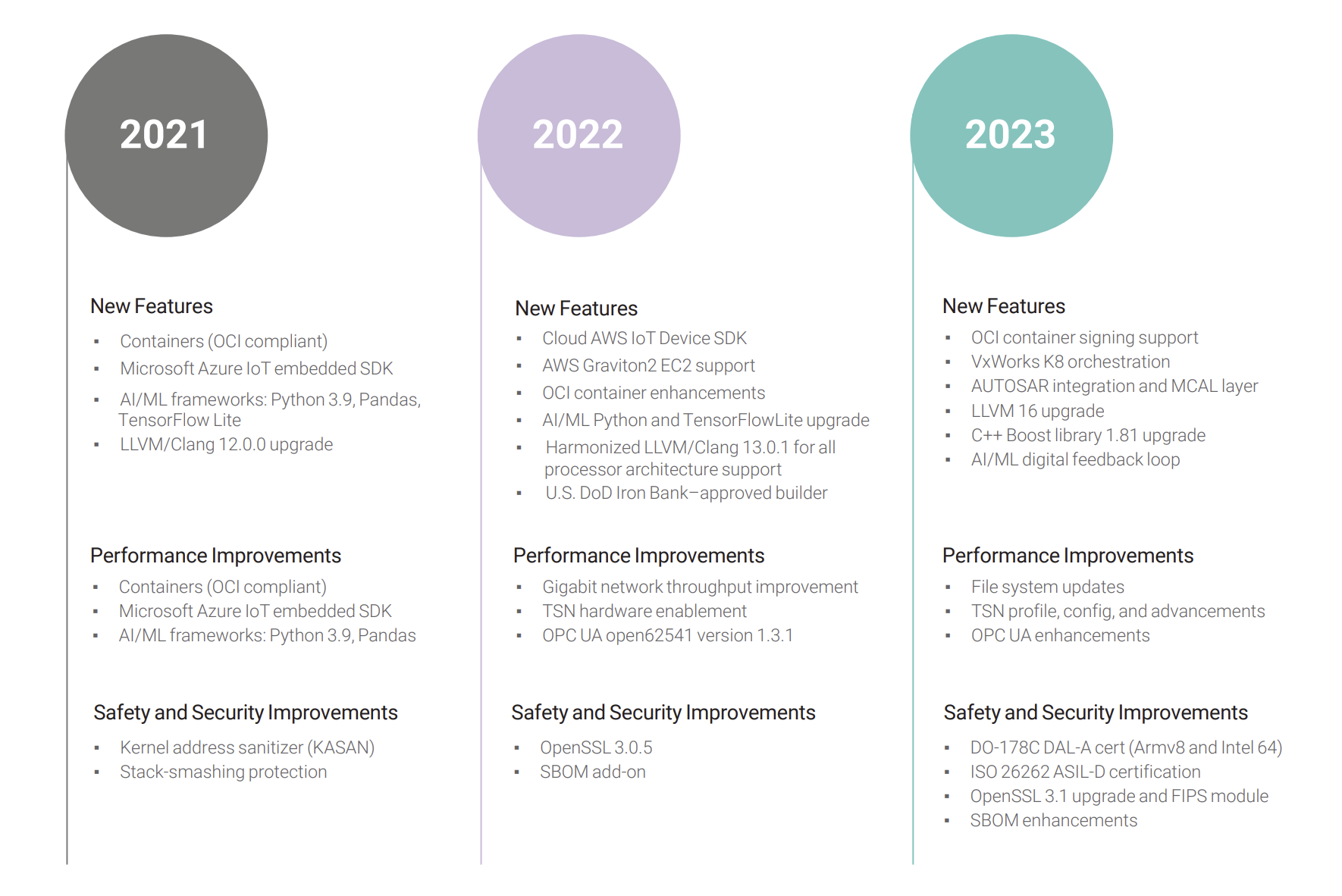
First introduced almost 30 years ago, VxWorks® has continually evolved to meet the changing requirements of a modern, deterministic, real-time operating system (RTOS). Today, that means advanced security features, cloud-native capabilities (including container support), support for the latest programming languages, and integration with artificial intelligence (AI) and machine learning (ML) technologies. VxWorks 7 has undergone significant enhancements since it was released in 2014. In the last three years alone, our development team has added a host of new capabilities and features, many of them specifically designed to address the challenges of the intelligent edge.
Artificial Intelligence/Machine Learning
In 2021, we added AI/ML frameworks to VxWorks 7 to support intelligent systems at the edge. Integration with AI/ML tools at the edge enables application developers to leverage real-time data processing, reduce latency, conserve network bandwidth, and create exciting new use cases for their business.
Open Container Initiative (OCI) Compliance
Also in 2021, VxWorks 7 became the first (and remains the only) RTOS to achieve OCI compliance. This means developers can use VxWorks 7 with Kubernetes orchestration to support agile software development processes, create portable applications with remote container management, and deploy smaller applications.
Container Registries
VxWorks 7 today works with a variety of leading container registries, including Amazon’s Elastic Container Registry (ECR), Docker Hub, and Harbor. This allows developers to reuse applications effectively across their business.
Hardware and Software Support
In 2022, we added Amazon’s Graviton EC2 processors to our list of hardware platforms that VxWorks 7 supports, giving our customers more freedom to explore deployment options in the cloud. At the same time, we expanded our SBOM to give customers a wider range of multi-vendor software options.
Kubernetes
In 2023, we introduced kubelets for VxWorks 7 that effectively brings Kubernetes to the intelligent edge. With the latest version of VxWorks 7, developers can create, deploy, and orchestrate containerized applications at the edge using Kubernetes.
Improved Performance
We’re continually optimizing and enhancing the performance of VxWorks to run better, faster, and more reliably. Some of our most recent enhancements include improved performance for Time-Sensitive Networking (TSN) applications, better kernel performance, and faster performance for applications using the OPC Foundation’s Unified Architecture.
Security Certifications
VxWorks 7 meets some of the world’s most stringent security certifications, including DO-178C (for the defense and aerospace industries) and ISO 26262 ASIL-D (for the automotive industry). To date, Wind River® has completed testing for more than 600 separate safety certification programs. In addition, we continually review thousands of common vulnerabilities and exposures (CVEs) each year to ensure that VxWorks is secure against the latest threats.
Programming Languages
VxWorks 7 recently added support for new programming languages, including C++ 17 and Rust.
Considerations Before You Upgrade
It’s not uncommon to find that systems with decades-long lifecycles (e.g., oil rigs, satellites) run an earlier version of VxWorks. While upgrading to VxWorks 7 has clear advantages, there are also some considerations to weigh before migrating your applications.
Architecture Support
We’ve updated the driver in VxWorks 7 to VxBus Gen 2, which is not only more efficient and more flexible than the earlier VxBus Gen 1 but also supports a wider range of hardware platforms, including those featuring Arm®, PowerPC, x86, and RISC-V processors. It’s important to note, however, that the Gen 2 VxBus drivers are not backward compatible with the Gen 1 drivers found in VxWorks 5.x implementations. You can always find the hardware platforms that are supported by using the VxWorks BSP Query tool at bsp.windriver.com.
Updated APIs
VxWorks 7 uses a different compiler and API calls than VxWorks 6 and older versions. When upgrading, you need to ensure that your applications are compatible with the new compiler. For example, some of your legacy API calls may not be supported in VxWorks 7. In those cases, you may need to rewrite parts of your application, which can be time-consuming.
Updated Integrated Development Environment (IDE)
We updated the IDE in VxWorks 7 and fully integrated it with Wind River Studio Developer to allow developers to more easily share artifacts and build RTOS images in the cloud. If you use Studio Developer and Wind River Studio Operator together, you can do even more: Deploy software (and deploy software updates) across clusters of devices, create digital feedback loops, and create digital twins. This presumes, however, that your development environment can handle cloud-native workloads. If not, it can be a substantial investment to support those workloads, particularly if you’re migrating from VxWorks 5. The migration from VxWorks 6 is easier, as you can still use Workbench (albeit an improved version) as your IDE in VxWorks 7.
User Authentication and Management
In VxWorks 7, we’ve replaced loginLib and IP-COM with improved authentication and user management tools. These improvements support more users and also work without a network stack — a noted drawback in previous versions of VxWorks.
Code Reusability for Certifications
The majority of applications running on VxWorks involve some kind of certification. If you’re migrating to a newer version of VxWorks, it can be costly to recertify existing applications. To reduce those costs, we’re creating reusable components that can be modularized and used when recertification is required.