SCALING AUTOMOTIVE SOFTWARE WITH WIND RIVER STUDIO TESTING SUITE


An automotive electronics supplier addressed software testing complexity by improving lab hardware utilization, streamlining validation workflows, and accelerating regression testing.

BATTLING BOTTLENECKS

A global automotive Tier 1 supplier develops software-intensive electronic control units (ECUs) across multiple vehicle domains. Each of these systems must undergo validation, a process of testing and verification to ensure the software performs as expected and meets functional and quality requirements. This becomes increasingly complex as software complexity, integration frequency, and release cadence grow. 

Traditional, hardware-centric validation workflows created bottlenecks in board access, test execution, and regression throughput. That made it difficult to support continuous integration and to iterate on software delivery cycles. 

The customer relied on distributed physical test benches and manual lab operations for validation across globally distributed teams. Geographic separation made hardware access and coordination difficult, while board preparation required manual intervention, and regression testing relied on sequential execution. These constraints reduced hardware utilization, slowed validation cycles, and limited the ability to scale testing.

A STREAMLINED SOLUTION

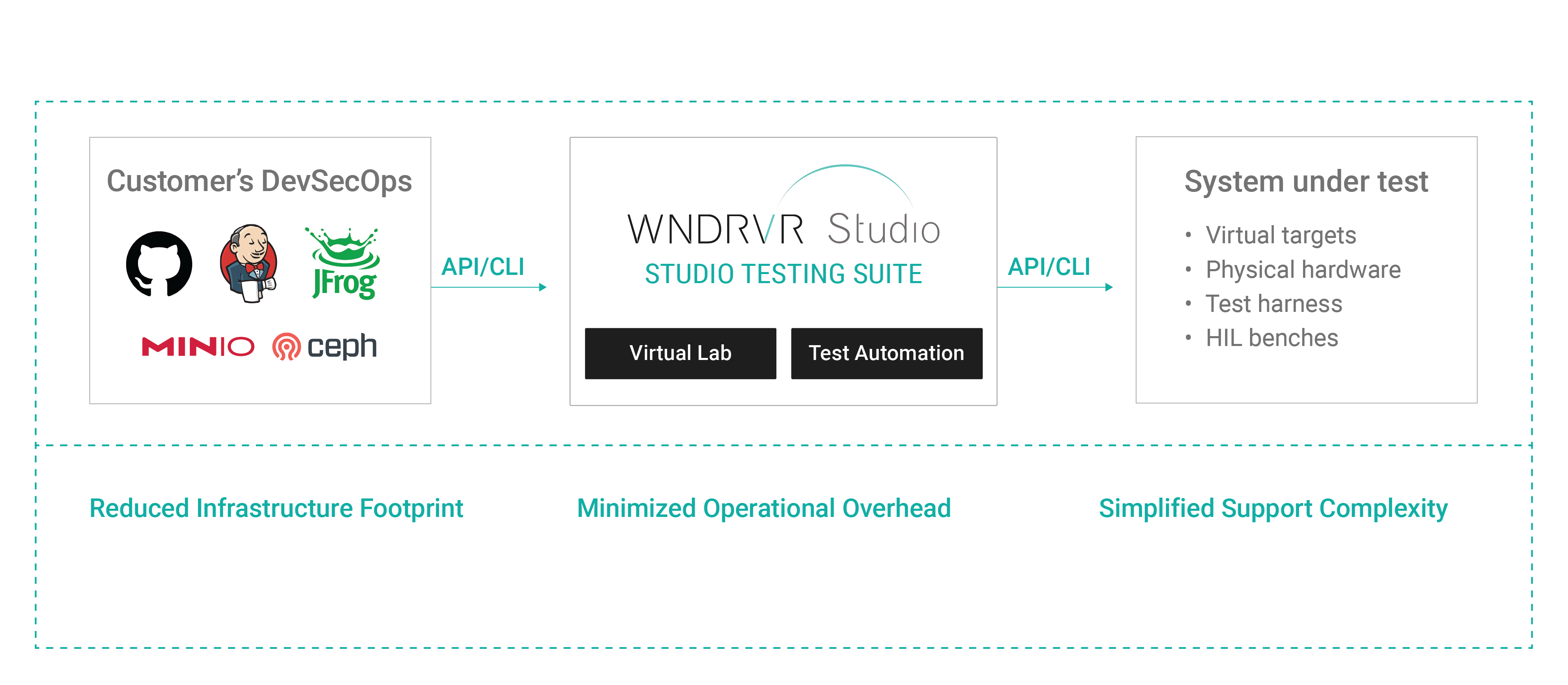
The automotive supplier deployed Wind River Studio Testing Suite, powered by Studio Virtual Lab and Studio Test Automation, to modernize its validation infrastructure while preserving existing hardware investments. Studio Virtual Lab centralized access to physical targets, enabling engineering teams to easily reserve, control, and interact with shared environments. Automated board operations such as flashing, boot control, and reset handling reduced manual effort and improved consistency across workflows. 

To scale further, the customer introduced Android emulator–based virtual targets. Engineering teams now could run functional and regression tests in parallel without competing for limited physical hardware. Doing so reduced bottlenecks and gave teams greater flexibility and confidence in their testing cycles. 

Studio Test Automation orchestrated validation across physical and virtual environments through CI/CD pipelines, enabling repeatable execution and faster feedback. Wind River® Professional Services integrated the solution into existing DevSecOps workflows, ensuring a smooth transition while establishing a scalable foundation for future validation needs.

Challenge 
  • Limited access to shared physical ECU targets across geographically distributed teams 
  • Manual flashing, boot sequencing, and board preparation that increased operational overhead 
  • Sequential test execution that constrained regression throughput and delayed feedback 
  • Expanding physical lab infrastructure that increased cost and operational complexity
Solution
  • Improved utilization of shared physical resources through centralized ECU target access
  • Reduced reliance on constrained hardware by leveraging Android emulator–based virtual targets 
  • Decreased manual lab operations while improving test consistenc
Results
  • Reduced integration defects by 20% to 30% due to physical target access via Virtual Lab
  • Achieved up to 30% faster turnaround in regression and functional test cycles through pipeline-triggered automation
  • Achieved 20% reduction in manual flashing, booting, and setup effort through automated testing workflows
  • Established a scalable foundation for hybrid digital twin testing, which combined physical and virtual targets and decreased quality delays by up to 50%

NEXT STEPS

Consider modernizing ECU validation infrastructure with Wind River Studio Testing Suite. Scale hardware-based validation without proportionally expanding lab infrastructure, and improve regression throughput with automated target orchestration.


Return to Resource Center