Mission-Critical Resiliency Protects All Three Planes

With enterprises and service providers relying on cloud infrastructure to support critical operations, business continuity is a foundational requirement — not an optional feature. Downtime, loss of control, and operational blind spots can result in revenue loss, erosion of customer trust, regulatory exposure, and competitive disadvantages.
Traditional cloud architectures have largely focused on availability within the data plane, replicating compute, storage, and networking resources to reduce downtime. While the approach is necessary, it is no longer sufficient.
Continuity failures increasingly originate above the data plane, within the control and management layers that orchestrate, configure, and govern cloud environments. When these layers are disrupted, workloads may continue to run, but organizations can no longer manage, recover, secure, or even access them. The result is uptime without continuity: infrastructure that remains powered on but no longer supports the business.
Addressing this challenge requires a cloud architecture designed to protect all three operational planes: data, control, and management.
INSIDE THE ARCHITECTURE
Wind River® Cloud Platform addresses the continuity challenge through a mission-critical resiliency architecture that ensures cloud operations remain visible, autonomous, and recoverable. They do so from core data centers to the farthest edge, even under fault conditions.
Rather than relying solely on centralized control or redundancy, the platform supports distributed, fault-isolated, and operationally autonomous environments.
Protecting the Data Plane
Resiliency begins with a robust data plane. Cloud Platform delivers high-availability compute, storage, and networking for cloud environments with stringent operational requirements, optimized for high performance and ultra-low latency.
The platform supports geographically distributed edge-to-core deployments with multisite management and subcloud grouping. Critical workloads and data remain accessible even during localized faults or infrastructure disruptions.
However, data plane availability alone does not guarantee continuity. True continuity extends into the control and management layers that govern cloud operations.
Distributing the Management Plane
Above the control layer, Cloud Platform uses a system controller — a logically centralized but nonoperationally critical management layer — to govern policies, configurations, and software lifecycle operations across distributed subclouds.
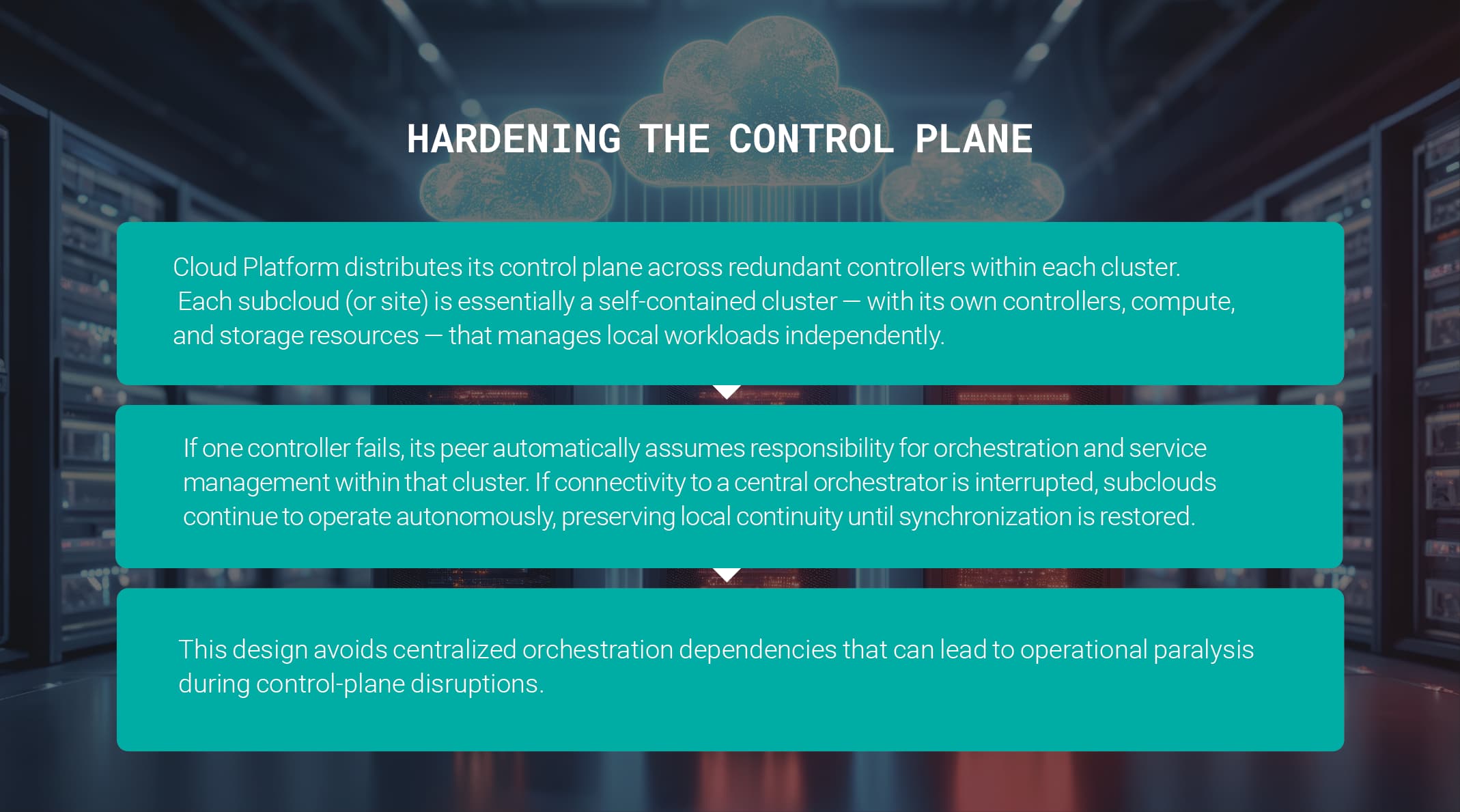
While the system controller provides centralized governance and visibility, it is not required for day-to-day workload operation. Each subcloud can operate locally, with local authentication and lifecycle management, to ensure continuity even when connectivity to the system controller is interrupted. This architecture limits the blast radius of management plane failures, which prevents centralized issues from cascading across sites or disrupting local operations. It is particularly well suited for sovereign, safety-critical, and intermittently connected environments, where uninterrupted local control is essential.
All configuration changes are version-controlled and validated through automated pipelines, enabling rapid rollback to a known-good state and preserving operational stability when anomalies are detected.
INTELLIGENCE THAT PREVENTS OUTAGES
Operational resiliency requires more than system health visibility. True resiliency anticipates risk and responds before operations are affected. With proactive insight, the system can highlight latent issues in distributed environments that otherwise could propagate into control- or management-plane failures, turning localized anomalies into widespread service disruptions.
Cloud Platform, combined with Wind River Analytics, delivers continuous visibility into the health and behavior of distributed cloud infrastructure. Real-time telemetry is collected from every subcloud, cluster, and node. Wind River Analytics then detects anomalies, forecasts potential failures, and optimizes system behavior.
Together, these capabilities allow organizations to identify and mitigate risk before it affects control or management functions, making Analytics an integral part of the continuity mechanism, rather than a mere monitoring capability.
BUILT FOR THE EDGE, READY FOR MISSION-CRITICAL OPERATIONS
Cloud Platform supports environments where failure is not an option — spanning traditional IT and operational technology (OT).
The platform enables:
- Local autonomy when connectivity is lost
- Consistent, low-latency performance for real-time applications
- Zero-trust protection across data, control, and management planes
- Operational sovereignty for regulated and national infrastructure environments
The result is uninterrupted business continuity, whether in a centralized data center or the most remote edge location.
CONTINUITY IS THE REAL KPI
Cloud platforms underpin critical national, industrial, and enterprise systems. In these environments, continuity, not uptime, is the true performance indicator.
Business continuity depends on maintaining control, visibility, and operational authority even when failures occur. It is the ability to continue operating that matters — protecting revenue, customer trust, and competitive position.
With Cloud Platform, organizations gain an infrastructure foundation that preserves continuity across data, control, and management planes, so that operations continue despite faults or disruptions.
That is the essence of mission-critical resiliency: not simply surviving faults but continuing to operate through them. Because in a cloud-connected world, continuity is the ultimate definition of resilience.