


Wind River Cloud Platform
An open source, on-premises, private cloud solution for virtualized and containerized applications

Organizations in enterprise and telecommunications sectors are rethinking how they deploy and operate infrastructure and workloads across distributed cloud environments, from edge locations to centralized data centers. Rising cloud costs, operational complexity, performance, and vendor lock-in are driving the search for more flexible, efficient, and scalable solutions.
Wind River® Cloud Platform provides a better way. Proved in some of the world’s largest and most mission-critical cloud deployments, it’s a commercially supported enterprise-grade solution based on open source technologies that enables enterprise IT organizations and telecommunications operators to deploy and manage virtualized and containerized workloads across distributed environments. It combines ultra-low latency and high availability with scalable infrastructure management, lifecycle automation, and a lightweight footprint.
KEY BENEFITS
- Cost efficiency: Reduce total cost of ownership with a smaller infrastructure footprint that frees more compute capacity for business workloads while lowering hardware and operational costs.
- Open source support: Avoid vendor lock-in with commercialized open source technologies, such as StarlingX, OpenStack, and Kubernetes, backed by Wind River’s award-winning customer support and services.
- Virtual machine (VM) and container support: Manage virtualized and containerized workloads from a single technology stack and management toolset.
- Multi-level scalability: Scale from compact edge deployments to large distributed and centralized cloud environments with consistent infrastructure management.
- Distributed-cloud operations: Deploy and manage mission-critical infrastructure across edge, regional, and centralized environments with remote management, high availability, and lifecycle automation.
- Zero-Trust protection: Secure mission-critical private cloud environments with greater consistency, operational control, and confidence, from edge to core.
- Compute and storage modernization: Modernize infrastructure with flexible compute and enterprise storage integration, strengthening business continuity and supporting mission-critical workloads.
AI-ready platform: Support AI workloads across distributed environments with high-performance infrastructure, enabling real-time processing and consistent execution, from edge to core.
KEY FEATURES
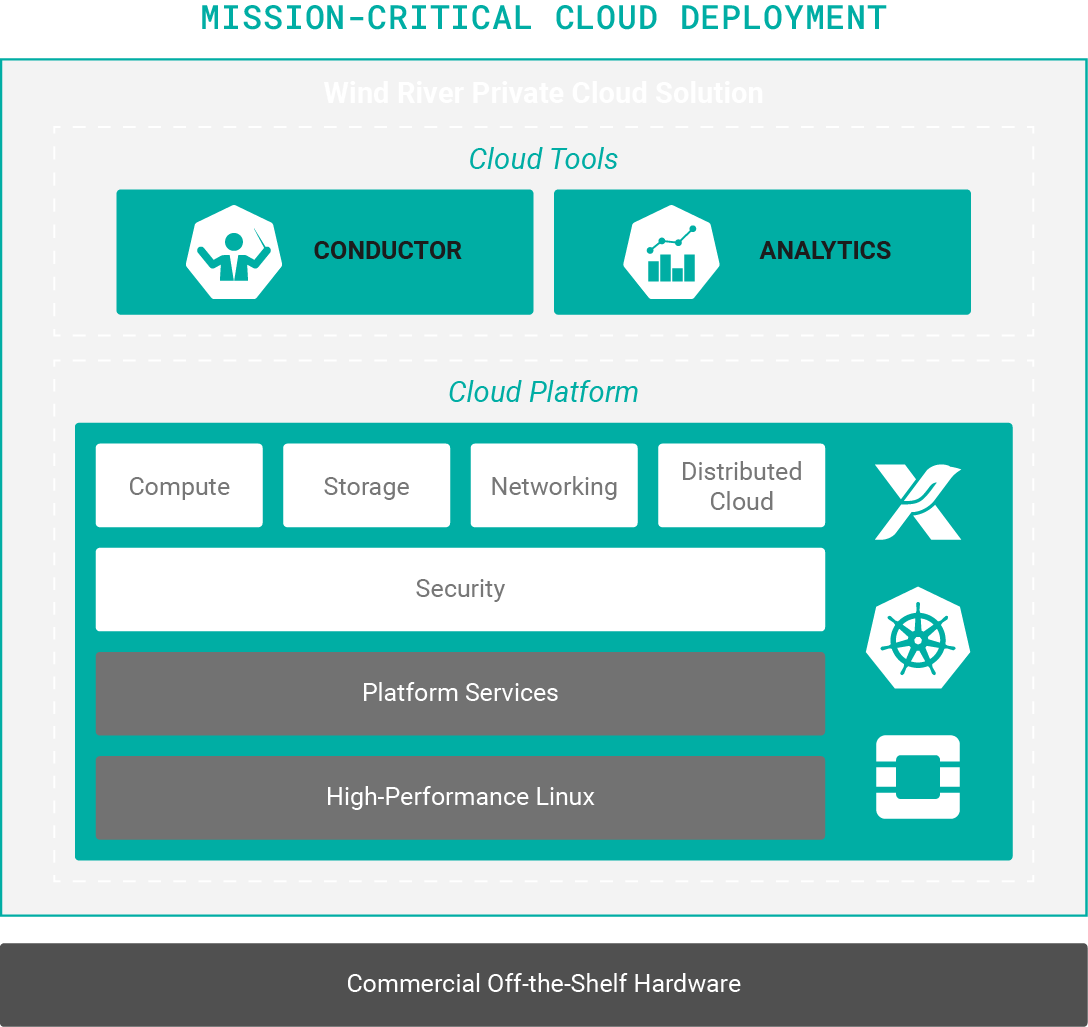
Cloud Platform is a key infrastructure component of Wind River Private Cloud Suite. The platform is designed to meet stringent requirements, including ultra-low latency, high availability, scalability, and security. From single-node edge deployments to geographically distributed clouds and large-scale centralized data centers, Cloud Platform offers a wide range of features, including:
- Support for single-node deployments, with integrated compute, storage, and control functions at the edge
- High availability and lifecycle management for mission-critical applications
- Security by design with Zero-Trust protection
- Scalability from a single node to large-scale distributed cloud environments
- High-performance infrastructure optimized for demanding workloads
INTELLIGENT INFRASTRUCTURE MANAGEMENT FOR DISTRIBUTED CLOUD
Cloud Platform provides comprehensive infrastructure management to simplify operations across distributed edge and core environments. Built on StarlingX, the platform enables centralized visibility and control of compute, storage, and networking resources with a lightweight, scalable architecture. It enables management of up to 10,000 nodes as a single distributed cloud and includes features that reduce operational complexity, including zero-touch provisioning, automated node deployment, accelerated subcloud enrollment, and seamless scaling. Advanced capabilities include hardware and software inventory tracking, self-healing orchestration, and rolling upgrades to reduce service disruption. Multisite management with subcloud grouping allows efficient oversight of geographically dispersed infrastructure, while API-driven automation and Kubernetes-native tools enhance operational efficiency. With built-in fault detection and secure lifecycle management, Cloud Platform allows deployment and maintenance of mission-critical infrastructure at scale.
Host management service offers full lifecycle control and availability of both hardware and host-level software. The platform detects and automatically recovers from hardware or software failures. It also performs monitoring, fault reporting, and automatic recovery for:
- Cluster connectivity
- Host failures
- Critical process failures
- Resource utilization thresholds and interface states
- Hardware and sensor faults
- Activity progress reporting
Cloud Platform also integrates with the baseboard management controller to enable out-of-band management of server hardware. Using industry-standard protocols such as Intelligent Platform Management Interface and Redfish, the platform provides secure, remote access to hardware resources independently of the operating system. Functions are accessible via REST APIs and tightly integrated into the platform’s fault-management framework, enabling automated detection and recovery across distributed environments.
Key capabilities include:
- Out-of-band reset for recovering unresponsive systems
- Power on and off to manage server states remotely
- Hardware sensor monitoring for real-time insights into temperature, voltage, and other critical metrics
Fault management service delivers a robust framework for monitoring, reporting, and recovering from faults across distributed environments. The platform provides centralized detection and management of alarms and events to ensure high availability of mission-critical workloads. It offers comprehensive visibility and control through REST APIs, the command-line interface (CLI), a GUI, and SNMP while automated policies and recovery actions enable rapid response to hardware and software issues at scale.
Key capabilities include:
- APIs to set, clear, and query alarms and log significant events
- Broad alarm coverage for platform nodes, hardware resources, and hosted virtual resources, including VMs, storage volumes, and networks
- Event ID–based alarm suppression to reduce unnecessary alarm notifications
- Multi-interface access (REST API, CLI, GUI/Horizon, SNMP) for active alarms, historical events, and suppression status
Software management service orchestrates upgrades and patches to host software seamlessly across distributed environments. The platform streamlines the deployment of new functionality and security updates while reducing upgrade duration and service interruption through rolling and in-place upgrades.
Key capabilities include:
- Management of all platform host software, including the kernel, operating system, StarlingX host services, containerized services, and system containers
- StarlingX Unified Software Management (USM) framework providing consistent REST API, CLI, and GUI workflows for both patches and major upgrades
- Support for orchestrated rolling upgrades enabling in-place updates without requiring additional hardware or extended downtime
Configuration management service automates inventory, commissioning, and system configuration of both hosts and infrastructure services. It streamlines deployment and setup for large-scale, distributed environments, making it an optimal choice for enterprise, telecommunications, and edge workloads. Configuration management service is tightly integrated with the platform’s orchestration and fault-management frameworks, enabling seamless deployment and full visibility into the system state.
Key capabilities include:
- Automated hardware discovery to locate processors (including CPUs, cores, and simultaneous multithreading capabilities), memory (including huge pages), storage, network ports, and crypto/compression devices
- Service-level settings to configure DNS, Network Time Protocol/Precision Time Protocol clients; REST API, CLI, and Horizon GUI container registry access; and other platform services
- Node commissioning and configuration to assign roles (controller, worker, storage), CPU/memory profiles, and interface/storage mappings
- Unified interfaces to manage inventory and configuration via REST API, CLI, and Horizon GUI
Service management ensures continuous operation of critical infrastructure services. The platform employs a distributed, active election architecture and robust messaging to maintain service health. High-availability mechanisms are fully integrated into the platform’s orchestration and fault management frameworks, supporting rapid recovery, resilience, and scalable operations.
Key capabilities include:
- Multi-path messaging: Allows up to three independent communication channels with a dual top-of-rack switch architecture, optionally aggregated using link aggregation, and with optional HMAC-SHA512 authentication to prevent split-brain scenarios
- Heartbeat-based monitoring: Provides periodic heartbeat messages through controllers, allowing peers to respond with cluster state and enabling rapid failure detection
- Active election process: Permits on-state changes (e.g., controller failover) and allows for minimal disruption when controllers share cluster status and elect new active roles
SUPPORTING VIRTUALIZED WORKLOADS
Wind River OpenStack is a deployment-ready add-on to Cloud Platform, with commercial testing, hardening, lifecycle support, and maintenance. Packaged as a set of modular containers, Wind River OpenStack runs alongside the Kubernetes environment, enabling virtualized and containerized workloads to run on the same server node across centralized and distributed deployments.
Deployment options range from single-node OpenStack, ideal for workloads requiring small edge clouds, to large, distributed clouds with thousands of geo-distributed nodes. Key capabilities include:
- Create a containerized Kubernetes application to ease deployment and updates
- Provide a hybrid cluster for hosting both containerized and virtualized workloads for improved management
- Follow an upstream-first development model within the StarlingX project of the OpenInfra Foundation to ensure a true open source approach
- Support live migration of VMs
- Provide high availability, performance, and low latency for demanding mission-critical use cases
- Support a wide range of guest operating systems and deployment configurations, including stand-alone and highly distributed cloud configurations
Wind River OpenStack also provides tenant-aware telemetry and operational visibility across virtualized environments. Resource-level VM monitoring, infrastructure observability, automated alarms, and autoscaling help operations teams monitor and manage workloads, while resource usage insights support capacity planning and internal cost allocation.
In addition to OpenStack, Cloud Platform integrates KubeVirt to support both virtualized and containerized workloads. By running KubeVirt within the same Kubernetes cluster, both VMs and containers can be managed on a single cloud infrastructure, reducing operational complexity, streamlining workload orchestration, and supporting a gradual transition to cloud-native architectures. The KubeVirt system application includes essential tools, such as the Containerized Data Importer for efficient data volume handling and the Virtctl client for managing VM lifecycles.
WORKLOAD CHOICE WITH OPERATIONAL CONSISTENCY
Cloud Platform provides an integrated software stack that includes both the underlying platform operating system and support for a broad range of workload operating environments. This architecture simplifies deployment and lifecycle management while preserving the flexibility to support existing virtualized applications and modern cloud-native workloads.
HOST OS (PLATFORM OS)
Cloud Platform includes a Wind River-provided Linux stack consisting of a Yocto-based Linux kernel and a Debian user space. The platform OS is integrated, validated, and maintained as part of the overall platform lifecycle, reducing the operational complexity of managing infrastructure software and the operating system separately.
Key benefits include:
- An integrated and validated platform OS delivered as part of the solution
- Single lifecycle management for the platform and operating system
- Simplified patching, updates, and security maintenance
- Reduced validation and interoperability testing requirements
- Consistent workload behavior across deployments, supporting applications with stringent latency, performance, or availability requirements
- Reduced operational complexity through a pre-integrated software stack
GUEST OS (WORKLOAD OS)
Cloud Platform supports both virtual machines and containers, preserving workload flexibility while enabling organizations to run existing VM-based applications alongside modern cloud-native workloads on a common infrastructure platform.
Supported workload environments include:
- Linux virtual machines, including common enterprise distributions such as Ubuntu, Debian, and RHEL
- Wind River eLxr Pro cloud images for lightweight, cloud-optimized Linux deployments
- OCI-compliant containerized applications
Key benefits include:
- Preserves flexibility for existing applications and operating environments
- Supports both legacy and cloud-native workloads on a common platform
- Enables infrastructure modernization without requiring workload re-architecture
- Allows organizations to modernize infrastructure at their own pace while maintaining application compatibility
PERFORMANCE WITHOUT COMPROMISE
Cloud Platform, built on StarlingX, delivers ultra-low latency and high throughput for demanding AI, telecommunications, and enterprise workloads. Support for the latest high-performance processor platforms, including Intel Xeon 6 and AMD EPYC, provides flexible compute options for performance-intensive deployments. Hardware acceleration technologies, including SR-IOV, Data Plane Development Kit (DPDK), and Intel Forward Error Correction offloading, combined with low-latency profiles and CPU resource management, provide predictable performance for demanding containerized and virtualized workloads.
Cloud Platform’s lightweight footprint also minimizes platform resource requirements, making more compute capacity available for business workloads and improving infrastructure efficiency at scale. Additional performance and resource-management capabilities include:
- Huge pages enable pods to allocate and consume memory from a pre-allocated huge page pool.
- Kubernetes CPU Manager static policy allows application pods to reserve exclusive ownership of CPUs and to ensure separation of platform pods from application pods.
- Kubernetes Topology Manager offers the option of ensuring that all CPU cores allocated to a pod are from the same non-uniform memory access zone.
- Node Feature Discovery detects hardware features available on each worker node and advertises those features using node labels.
- Application-isolated CPUs isolate CPUs completely from the host process scheduler and make them available to pods.
COMPUTE AND STORAGE MODERNIZATION IN ONE MOVE
Cloud Platform delivers a flexible compute and storage architecture optimized for both edge and centralized cloud environments, enabling organizations to modernize infrastructure while strengthening business continuity. This architecture enables independent scaling of compute and storage resources while supporting diverse infrastructure strategies across distributed environments. Flexible storage options, including Ceph managed through Rook and LVM, give organizations greater choice in how storage is deployed and managed, with migration and rollback capabilities that simplify the evolution of storage architectures over time.
Support for enterprise storage protocols such as Fibre Channel, iSCSI, and NFS enables integration with external storage systems, with multipath configurations providing enhanced redundancy and failover protection. Support for NVMe, SSD, and HDD devices provides additional flexibility across different storage requirements. Wind River OpenStack further expands storage choice through external storage backend integration, enabling customers to integrate supported third-party enterprise storage platforms without requiring native platform validation for each storage backend.
Cloud Platform also supports these external storage options as part of an expanding ecosystem:
- NetApp Trident integration for NetApp storage systems
- Dell Container Storage Interface/Container Storage Modules integration for Dell data storage products
ADVANCED NETWORKING
To simplify network provisioning and scaling across distributed sites, Cloud Platform delivers a software-defined networking framework for both edge and centralized cloud environments, offering ultra-low latency, high throughput, and enhanced performance for mission-critical workloads. Cloud Platform provides a pre-integrated, lifecycle-managed networking stack that includes Calico, Multus, and SR-IOV capabilities, reducing the integration and lifecycle-management burden associated with assembling these components separately.
With support for hardware acceleration, IPv4/IPv6 dual-stack, VLAN-aware networking, and advanced traffic management, the platform provides a unified networking foundation for virtualized and containerized workloads. Key capabilities include:
- Calico and Multus CNI for default pod networking and multiple network interfaces per Kubernetes pod
- SR-IOV device plugin and CNI to enable hardware resource scheduling and direct network-interface access for high-performance workloads
- Distributed Virtual Switch for efficient traffic management of virtualized workloads
- DPDK for acceleration of packet processing
BUILT-IN SECURITY
Cloud Platform delivers a defense-in-depth security architecture designed to protect mission-critical workloads across distributed edge and core environments. It combines system-level protections, centralized identity integration, and modern cryptographic trust mechanisms to help enforce consistent security policies and protect communications at scale.
Key security capabilities include:
- Secure platform foundation: Secure boot, kernel hardening, and encrypted communications to help protect system integrity from the hardware layer through the operating system
- Centralized identity integration (OIDC, LDAP/AD): Integrates with enterprise identity providers using OpenID Connect and supports LDAP and Active Directory to enable centralized authentication and identity management across distributed environments
- Multifactor authentication support: Works with enterprise identity providers to enforce MFA, strengthening access security for critical systems and interfaces
- Role-based access control: Enforces least-privilege access policies, reducing risk of unauthorized access and privilege escalation
- Signed and validated images: Ensures that only trusted container images are deployed, helping to prevent the introduction of compromised workloads
- Automated vulnerability management: Streamlines patching and updates to address known vulnerabilities and maintain a strong security posture
- Continuous monitoring and protection: Provides ongoing visibility and detection capabilities to help identify and respond to potential threats
- Modern cryptographic trust: Strengthens protection for distributed infrastructure with modern encryption algorithms, configurable TLS protocols and cipher suites, and enhanced PKI and certificate lifecycle management
ENTERPRISE AND CARRIER SUPPORT
Wind River Private Cloud Suite is backed by an award-winning global support organization that offers live help in multiple time zones, with 24/7 emergency recovery and service restoration and standard Tier 1 and Tier 2 break/fix support. Premium services are available for even faster resolution.
For more information, visit www.windriver.com/support.
HOW TO PURCHASE
Transform how you deploy and manage resilient, scalable, and secure private clouds — with minimal operational overhead and maximum performance. Wind River Cloud Platform helps organizations achieve cost efficiency, real-time capability, and long-term infrastructure flexibility. Reach out to your Wind River account manager or visit us at www.windriver.com/contact to get started.